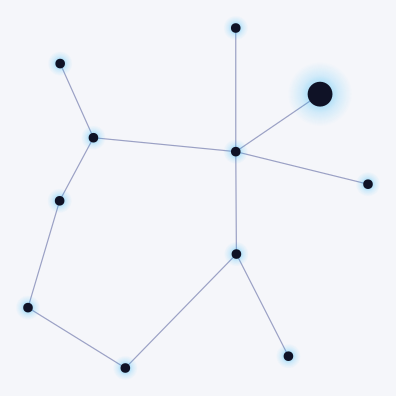
What it looks like
Auriga is a large northern constellation drawn as a charioteer holding reins and a goat across his shoulder. Its brightest star, Capella, is the sixth-brightest in the night sky. A small triangle of stars nearby — the Kids — sits at the charioteer's hand. Auriga is shared at one corner with Taurus's star Elnath.
Brightest stars
Auriga is dominated by Capella, a brilliant yellow-white star, with three more stars brighter than magnitude 2.7.
| Star | Magnitude | Distance | Meaning |
|---|---|---|---|
| Capella (α Aurigae) | +0.08 | 43 ly | The Little Goat |
| Menkalinan (β Aurigae) | +1.90 | 82 ly | Shoulder of the Charioteer |
| Mahasim (θ Aurigae) | +2.62 | 173 ly | — |
| Hassaleh (ι Aurigae) | +2.69 | 490 ly | — |
| Elnath (β Tauri, shared) | +1.65 | 134 ly | The Butting One |
Mythology and history
In Greek myth, Auriga is usually identified with Erichthonius, the lame king of Athens who invented the four-horse chariot.
Erichthonius the inventor
Auriga is commonly identified with Erichthonius, son of Hephaestus and Gaia, who was raised by Athena and became king of Athens. Born with deformed legs, he invented the four-horse chariot so he could move like other men. Zeus placed him in the sky in honour of his ingenuity, along with the goat Amalthea that had nursed the infant Zeus. Another tradition identifies the charioteer with Myrtilus, the charioteer of King Oenomaus, or with Phaethon, who lost control of the Sun's chariot.
How to find it
Look for bright Capella almost overhead on winter evenings, with the small triangle of the Kids just to its south.
- Capella forms one corner of the Winter Hexagon with Sirius, Procyon, Rigel, Aldebaran and Pollux.
- Look for the small triangle of the Kids below Capella.
- Best on winter evenings from the northern hemisphere.
Key facts
- Abbreviation
- Aur
- Genitive
- Aurigae
- Meaning
- The Charioteer
- Brightest star
- Capella
- Main stars
- 6
- Area rank
- 21st
- Best visible
- February
- Declination
- +40°
- Meteor showers
- Aurigids, Delta Aurigids
- Neighbours
- Camelopardalis, Perseus, Taurus, Gemini, Lynx
Deep-sky objects
Auriga is rich in open clusters, including M36, M37 and M38 — three fine clusters visible in binoculars — plus the Flaming Star Nebula (IC 405) and the Spider and Fly nebulae.
Frequently asked questions
What does the constellation Auriga look like?
Auriga is a northern constellation known as the Charioteer, marked by the brilliant star Capella and a small triangle of fainter stars called the Kids.
What is the brightest star in Auriga?
The brightest star in Auriga is Capella, shining at around magnitude 0.08.
When is Auriga best visible?
Auriga is best seen from northern hemisphere during February.
What is the story behind Auriga?
In Greek myth, Auriga is usually identified with Erichthonius, the lame king of Athens who invented the four-horse chariot.
Which constellations are near Auriga?
Auriga borders Camelopardalis, Perseus, Taurus, Gemini and Lynx.

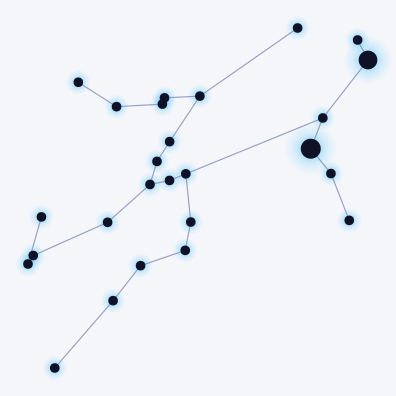 Taurus
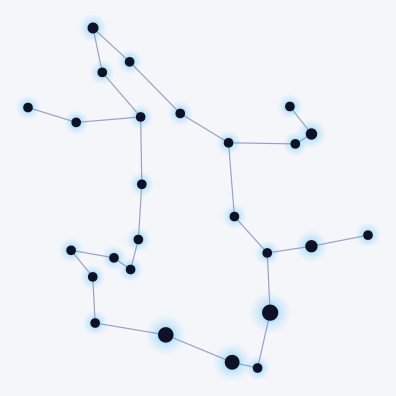 Perseus