
What it looks like
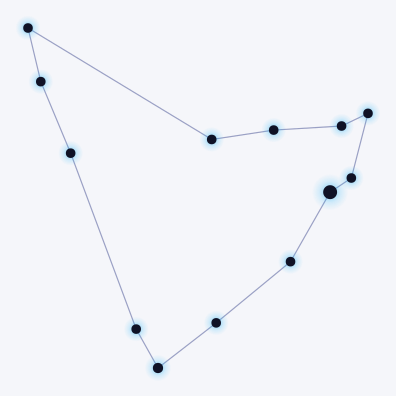
Microscopium is a small southern constellation created by Lacaille as part of his reorganisation of the southern sky. It represents the microscope, one of the instruments of scientific observation, and sits in a largely empty region south of Capricornus. Its brightest star, Gamma Microscopii, sits just above magnitude 4.6.
Brightest stars
Microscopium has no stars brighter than magnitude 4.6, making it one of the faintest constellations in the sky.
| Star | Magnitude | Distance | Meaning |
|---|---|---|---|
| Gamma Microscopii | +4.67 | 223 ly | — |
| Epsilon Microscopii | +4.71 | 165 ly | — |
| Theta-1 Microscopii | +4.80 | 186 ly | — |
| Alpha Microscopii | +4.89 | 380 ly | — |
Mythology and history
Microscopium has no ancient mythology. It was created by Lacaille in 1756 and named after the microscope, the instrument that opened up the world of the very small.
A microscope in the sky
Microscopium was introduced by Lacaille in 1756, along with several other southern constellations named for scientific instruments. The microscope had been developed in the Netherlands in the late 16th century, and by Lacaille's time it was one of the central tools of the natural sciences. Placed between Capricornus and Piscis Austrinus, Microscopium is one of the smallest and faintest of Lacaille's additions, but it stands as a lasting symbol of the union between astronomy and the other sciences.
How to find it
Look between Capricornus and Piscis Austrinus on autumn evenings from the southern hemisphere.
- Find Fomalhaut in Piscis Austrinus, then look north.
- Very faint — use a star chart or planetarium app.
- Best from the southern hemisphere on autumn evenings.
Key facts
- Abbreviation
- Mic
- Genitive
- Microscopii
- Meaning
- The Microscope
- Brightest star
- Gamma Microscopii
- Main stars
- 4
- Area rank
- 66th
- Best visible
- September
- Declination
- -35°
- Meteor showers
- —
- Neighbours
- Capricornus, Piscis Austrinus, Grus, Indus, Telescopium, Sagittarius
Deep-sky objects
Microscopium has few bright deep-sky objects. It contains several faint galaxies, including the Microscopium Void — a large, relatively empty region of space — and the faint spiral galaxy NGC 6925.
Frequently asked questions
What does the constellation Microscopium look like?
Microscopium is a faint southern constellation introduced by Lacaille in 1756, named after the microscope and lying between Capricornus and Grus.
What is the brightest star in Microscopium?
The brightest star in Microscopium is Gamma Microscopii, shining at around magnitude 4.67.
When is Microscopium best visible?
Microscopium is best seen from southern hemisphere during September.
What is the story behind Microscopium?
Microscopium has no ancient mythology. It was created by Lacaille in 1756 and named after the microscope, the instrument that opened up the world of the very small.
Which constellations are near Microscopium?
Microscopium borders Capricornus, Piscis Austrinus, Grus, Indus, Telescopium and Sagittarius.

 Capricornus
 Piscis Austrinus