
What it looks like
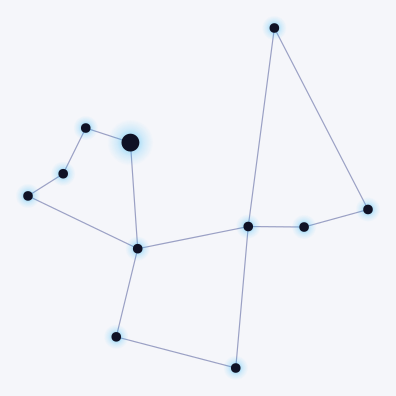
Indus is a modest southern constellation introduced by Petrus Plancius in 1598, drawn as a human figure holding arrows or a spear — the only constellation in the sky that represents a modern (non-European) human figure rather than a Greek mythological character. Its stars are faint, its brightest reaching only magnitude 3.1, and it lies in a quiet region of the southern sky.
Brightest stars
Indus has no bright stars; its brightest, Alpha Indi, sits near magnitude 3.1.
| Star | Magnitude | Distance | Meaning |
|---|---|---|---|
| Alpha Indi | +3.11 | 98 ly | — |
| Beta Indi | +3.65 | 600 ly | — |
| Theta Indi | +4.39 | 98 ly | — |
| Delta Indi | +4.40 | 185 ly | — |
Mythology and history
Indus has no ancient mythology. It was created in 1598 by Petrus Plancius and named after the indigenous people of the East Indies encountered by Dutch explorers.
The Indian of the southern sky
Indus was introduced by Petrus Plancius in 1598, using star positions recorded by Dutch navigators on their East Indies voyages. It was the first and remains one of the very few constellations to represent a real human being — a person of the East Indies — rather than a Greek or Roman mythological figure. Along with Tucana, Pavo, Apus and Chamaeleon, it belongs to a family of Plancius's southern constellations that honoured the people, animals and birds of the lands Dutch sailors were exploring.
How to find it
Look between Grus and Pavo on autumn and winter evenings from the southern hemisphere.
- Find bright Peacock in Pavo, then look west.
- Very faint — use a star chart or planetarium app.
- Best from the southern hemisphere on autumn and winter evenings.
Key facts
- Abbreviation
- Ind
- Genitive
- Indi
- Meaning
- The Indian
- Brightest star
- Alpha Indi
- Main stars
- 4
- Area rank
- 49th
- Best visible
- September
- Declination
- -55°
- Meteor showers
- —
- Neighbours
- Microscopium, Sagittarius, Telescopium, Pavo, Octans, Tucana, Grus
Deep-sky objects
Indus contains the bright galaxy NGC 7049, an unusual lenticular galaxy with prominent dust lanes, and the faint galaxies NGC 7090 and NGC 7144. The constellation also contains the epsilon Indi Ba/Bb binary — a pair of brown dwarfs orbiting a nearby star.
Frequently asked questions
What does the constellation Indus look like?
Indus is a faint southern constellation named for the Indian, introduced in 1598 and lying between Grus, Pavo and Tucana in a star-poor region near the south celestial pole.
What is the brightest star in Indus?
The brightest star in Indus is Alpha Indi, shining at around magnitude 3.11.
When is Indus best visible?
Indus is best seen from southern hemisphere during September.
What is the story behind Indus?
Indus has no ancient mythology. It was created in 1598 by Petrus Plancius and named after the indigenous people of the East Indies encountered by Dutch explorers.
Which constellations are near Indus?
Indus borders Microscopium, Sagittarius, Telescopium, Pavo, Octans, Tucana and Grus.

 Grus
 Pavo