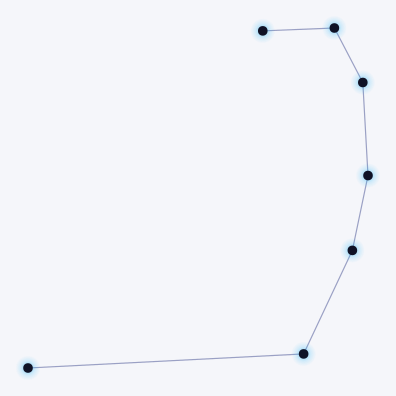
What it looks like
Corona Australis is the southern counterpart to Corona Borealis, drawn as a wreath or crown of stars. It sits just below the spout of the Sagittarius Teapot, and although its stars are faint — none brighter than magnitude 4 — the arc shape is distinctive under dark skies. The constellation contains the Corona Australis Molecular Cloud, one of the nearest star-forming regions to the Sun.
Brightest stars
Corona Australis has no bright stars; its brightest, Alfecca Meridiana, sits near magnitude 4.1.
| Star | Magnitude | Distance | Meaning |
|---|---|---|---|
| Alfecca Meridiana (α CrA) | +4.10 | 130 ly | — |
| Beta Coronae Australis | +4.10 | 508 ly | — |
| Gamma Coronae Australis | +4.23 | 58 ly | — |
| Delta Coronae Australis | +4.57 | 175 ly | — |
Mythology and history
In Greek myth, Corona Australis was sometimes seen as the crown of Sagittarius, or as a wreath laid down by the gods in honour of a hero.
A wreath of the gods
Corona Australis has no single fixed myth. Ancient sources describe it as a wreath or crown placed in the sky, sometimes attributed to Sagittarius and sometimes to the centaur Chiron. Aratus calls it 'the Crown' and notes its position beneath the Archer's feet. Some traditions link it to the crown of Dionysus, others to a wreath given by the gods in honour of a fallen hero. Unlike Corona Borealis, the northern crown, its origin story was never firmly settled in antiquity.
How to find it
Look just below the spout of the Teapot in Sagittarius on winter and spring evenings from the southern hemisphere.
- Find the Teapot in Sagittarius, then look south.
- The arc is faint — best seen from dark skies.
- Best from the southern hemisphere on winter and spring evenings.
Key facts
- Abbreviation
- CrA
- Genitive
- Coronae Australis
- Meaning
- The Southern Crown
- Brightest star
- Alfecca Meridiana
- Main stars
- 6
- Area rank
- 80th
- Best visible
- August
- Declination
- -40°
- Meteor showers
- —
- Neighbours
- Sagittarius, Scorpius, Ara, Telescopium
Deep-sky objects
The Corona Australis Molecular Cloud is one of the nearest star-forming regions to the Sun, about 430 light-years away, containing the reflection nebulae NGC 6726, NGC 6727 and NGC 6729, plus the variable star R Coronae Australis. The constellation also contains the globular clusters NGC 6541 and NGC 6723.
Frequently asked questions
What does the constellation Corona Australis look like?
Corona Australis is a small southern constellation known as the Southern Crown, a curved arc of faint stars tucked beneath the feet of Sagittarius.
What is the brightest star in Corona Australis?
The brightest star in Corona Australis is Alfecca Meridiana, shining at around magnitude 4.10.
When is Corona Australis best visible?
Corona Australis is best seen from southern hemisphere during August.
What is the story behind Corona Australis?
In Greek myth, Corona Australis was sometimes seen as the crown of Sagittarius, or as a wreath laid down by the gods in honour of a hero.
Which constellations are near Corona Australis?
Corona Australis borders Sagittarius, Scorpius, Ara and Telescopium.

 Sagittarius
 Scorpius