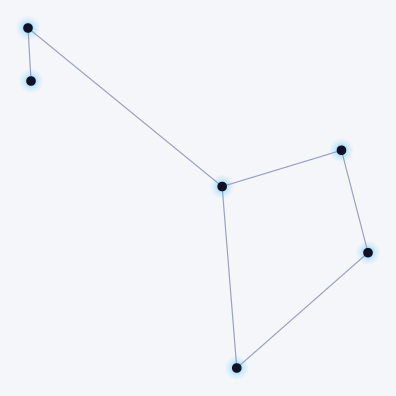
What it looks like
Chamaeleon is a small southern constellation introduced by Petrus Plancius in 1598, drawn as a chameleon. It lies near the south celestial pole, between Musca and Octans, in a relatively star-poor region of the sky. Despite faint stars, the constellation contains the Chamaeleon dark clouds — a nearby star-forming complex — and part of the Chamaeleon I molecular cloud.
Brightest stars
Chamaeleon has no bright stars; its brightest, Alpha Chamaeleontis, sits near magnitude 4.1.
| Star | Magnitude | Distance | Meaning |
|---|---|---|---|
| Alpha Chamaeleontis | +4.07 | 64 ly | — |
| Gamma Chamaeleontis | +4.11 | 413 ly | — |
| Beta Chamaeleontis | +4.24 | 271 ly | — |
| Theta Chamaeleontis | +4.35 | 155 ly | — |
Mythology and history
Chamaeleon has no ancient mythology. It was created in 1598 by Petrus Plancius from Dutch navigators' observations and named after the chameleon of the East Indies.
A lizard of the East Indies
Chamaeleon was introduced by Petrus Plancius in 1598, using star positions recorded by Pieter Dirkszoon Keyser and Frederick de Houtman on their voyages to the East Indies. It was later included by Bayer in the Uranometria of 1603. The chameleon — a lizard known for changing colour — was among the exotic creatures Dutch sailors encountered on their travels, and Plancius placed it in the sky along with its companions Apus (the bird of paradise), Tucana (the toucan) and Pavo (the peacock).
How to find it
Look near the south celestial pole, between Musca and Octans, on autumn and winter evenings from the southern hemisphere.
- Find the Southern Cross, then look south toward the pole.
- Faint and star-poor — use a chart or app.
- Best from the southern hemisphere on autumn and winter evenings.
Key facts
- Abbreviation
- Cha
- Genitive
- Chamaeleontis
- Meaning
- The Chameleon
- Brightest star
- Alpha Chamaeleontis
- Main stars
- 4
- Area rank
- 79th
- Best visible
- April
- Declination
- -80°
- Meteor showers
- —
- Neighbours
- Carina, Volans, Mensa, Octans, Apus, Musca
Deep-sky objects
The Chamaeleon dark clouds (Chamaeleon I, II and III) form a nearby star-forming complex about 500 light-years away, containing young stars and Herbig-Haro objects. The constellation also contains the open cluster NGC 3195 and the faint spiral galaxy NGC 3145.
Frequently asked questions
What does the constellation Chamaeleon look like?
Chamaeleon is a small southern constellation named for the colour-changing lizard, sitting near the south celestial pole and containing the Chamaeleon dark clouds.
What is the brightest star in Chamaeleon?
The brightest star in Chamaeleon is Alpha Chamaeleontis, shining at around magnitude 4.07.
When is Chamaeleon best visible?
Chamaeleon is best seen from southern hemisphere during April.
What is the story behind Chamaeleon?
Chamaeleon has no ancient mythology. It was created in 1598 by Petrus Plancius from Dutch navigators' observations and named after the chameleon of the East Indies.
Which constellations are near Chamaeleon?
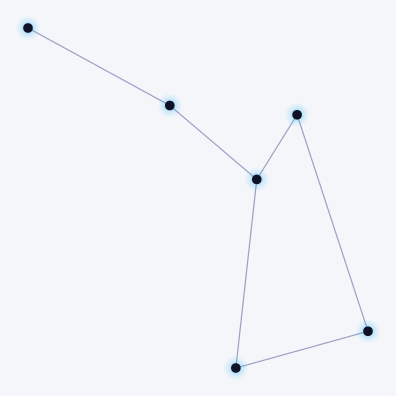
Chamaeleon borders Carina, Volans, Mensa, Octans, Apus and Musca.

 Musca
 Apus