
What it looks like
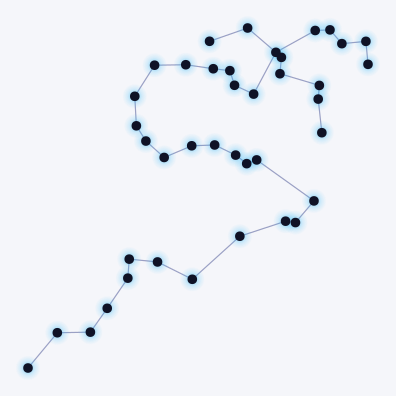
Phoenix is a mid-sized southern constellation drawn as the legendary bird rising from flames. It lies between Grus and Eridanus in the southern sky. Its brightest star, Ankaa, is an orange giant of magnitude 2.4 that anchors the constellation's shape.
Brightest stars
Phoenix is anchored by Ankaa, an orange giant, with several other stars in the third and fourth magnitude range.
| Star | Magnitude | Distance | Meaning |
|---|---|---|---|
| Ankaa (α Phoenicis) | +2.40 | 77 ly | The Phoenix |
| Beta Phoenicis | +3.32 | 198 ly | — |
| Gamma Phoenicis | +3.41 | 235 ly | — |
| Epsilon Phoenicis | +3.88 | 140 ly | — |
Mythology and history
Phoenix has no ancient mythology as a constellation. It was created in 1598 and takes its name from the legendary firebird of Greek, Egyptian and Eastern tradition.
The bird of fire
Phoenix the constellation was introduced in 1598 by Petrus Plancius, and takes its name from the legendary phoenix — a bird that lives for centuries, dies in flames, and is reborn from its own ashes. The legend appears in Greek sources such as Herodotus and Ovid, and may have Egyptian or Eastern roots. As a constellation, Phoenix has no myth of its own, but its name is a fitting one for a bird in the southern sky, drawn with wings spread and head raised, appearing to rise from the horizon.
How to find it
Look between Grus and Eridanus in the southern sky on late autumn and winter evenings.
- Find Ankaa first — it's the brightest star in the region.
- Fomalhaut in Piscis Austrinus points the way south.
- Best from the southern hemisphere on spring and autumn evenings.
Key facts
- Abbreviation
- Phe
- Genitive
- Phoenicis
- Meaning
- The Firebird
- Brightest star
- Ankaa
- Main stars
- 6
- Area rank
- 37th
- Best visible
- November
- Declination
- -50°
- Meteor showers
- Phoenicids, July Phoenicids
- Neighbours
- Sculptor, Grus, Tucana, Hydrus, Eridanus, Fornax
Deep-sky objects
Phoenix contains several notable galaxy clusters, including the Phoenix Cluster — one of the most massive known — and the Phoenix Dwarf galaxy, a small irregular satellite of the Milky Way. The constellation also contains the faint planetary nebula NGC 3195.
Frequently asked questions
What does the constellation Phoenix look like?
Phoenix is a southern constellation named for the mythical firebird, introduced in 1598 by Petrus Plancius, with the bright orange star Ankaa marking the bird's head.
What is the brightest star in Phoenix?
The brightest star in Phoenix is Ankaa, shining at around magnitude 2.40.
When is Phoenix best visible?
Phoenix is best seen from southern hemisphere during November.
What is the story behind Phoenix?
Phoenix has no ancient mythology as a constellation. It was created in 1598 and takes its name from the legendary firebird of Greek, Egyptian and Eastern tradition.
Which constellations are near Phoenix?
Phoenix borders Sculptor, Grus, Tucana, Hydrus, Eridanus and Fornax.

 Grus
 Eridanus