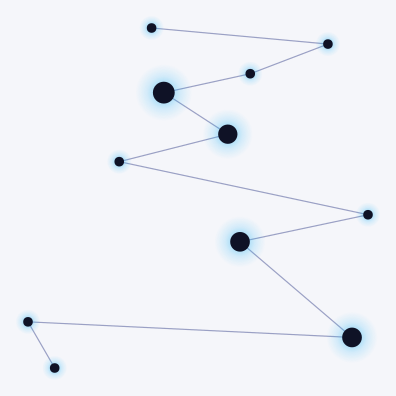
What it looks like
Lacerta is a small northern constellation created by Johannes Hevelius in 1687 to fill the gap between Cygnus, Cassiopeia, Andromeda and Pegasus. Though its stars are faint — none brighter than magnitude 4.4 — they form a zigzag line that is easy to trace, and the constellation lies within the Milky Way, giving it several fine open clusters.
Brightest stars
Lacerta has no bright stars; its brightest, Alpha Lacertae, sits near magnitude 3.8.
| Star | Magnitude | Distance | Meaning |
|---|---|---|---|
| Alpha Lacertae | +3.76 | 102 ly | — |
| 1 Lacertae | +4.14 | 620 ly | — |
| Beta Lacertae | +4.42 | 170 ly | — |
| Delta Lacertae | +4.43 | 165 ly | — |
Mythology and history
Lacerta has no ancient mythology. It was created in 1687 by Johannes Hevelius, who named it after the lizard because its faint zigzag of stars suggested the shape of the animal.
Hevelius's lizard
Lacerta was introduced by the Polish astronomer Johannes Hevelius in his star atlas of 1687, the same year he introduced several other small northern constellations. He named it Lacerta — the lizard — because the zigzag line of its stars suggested the shape of the animal, and because the lizard was a symbol of patience and careful observation in the emblem books of his time. The constellation lies in the Milky Way between Cygnus and Andromeda, and although it contains no bright stars, it is rich in open clusters visible in binoculars.
How to find it
Look between Cygnus and Andromeda on autumn evenings — a faint zigzag pattern inside the band of the Milky Way.
- Find Deneb in Cygnus, then look east toward Andromeda.
- The zigzag pattern is distinctive under dark skies.
- Best on autumn evenings from the northern hemisphere.
Key facts
- Abbreviation
- Lac
- Genitive
- Lacertae
- Meaning
- The Lizard
- Brightest star
- Alpha Lacertae
- Main stars
- 4
- Area rank
- 68th
- Best visible
- October
- Declination
- +45°
- Meteor showers
- —
- Neighbours
- Andromeda, Cassiopeia, Cepheus, Cygnus, Pegasus
Deep-sky objects
Lacerta contains the open clusters NGC 7243 and NGC 7209, both visible in binoculars, plus the faint planetary nebula IC 5217. The constellation also contains BL Lacertae — the prototype of the BL Lacertae objects, a class of active galactic nuclei.
Frequently asked questions
What does the constellation Lacerta look like?
Lacerta is a small northern constellation known as the Lizard, introduced by Hevelius in 1687 and lying between Cygnus, Cassiopeia and Andromeda.
What is the brightest star in Lacerta?
The brightest star in Lacerta is Alpha Lacertae, shining at around magnitude 3.76.
When is Lacerta best visible?
Lacerta is best seen from northern hemisphere during October.
What is the story behind Lacerta?
Lacerta has no ancient mythology. It was created in 1687 by Johannes Hevelius, who named it after the lizard because its faint zigzag of stars suggested the shape of the animal.
Which constellations are near Lacerta?
Lacerta borders Andromeda, Cassiopeia, Cepheus, Cygnus and Pegasus.

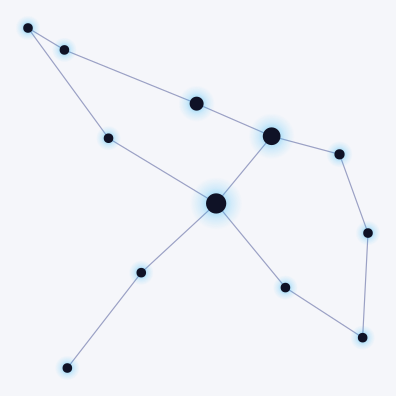 Cygnus
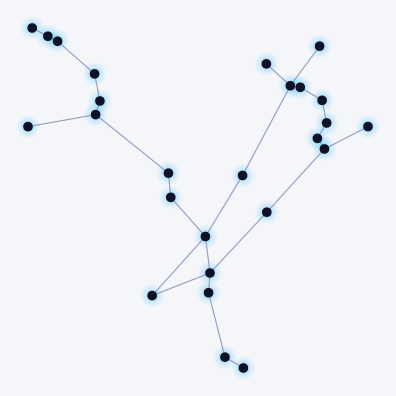 Andromeda