What it looks like
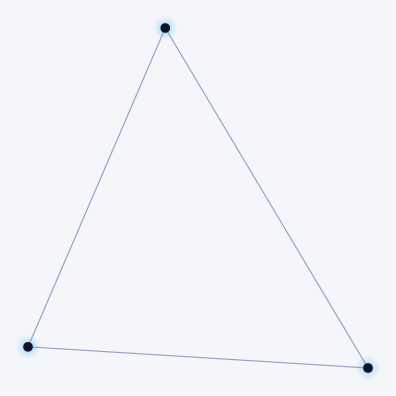
Triangulum Australe is a small but bright southern constellation introduced by Petrus Plancius in 1598, drawn as a triangle — the southern counterpart to the northern Triangulum. Its three brightest stars are all visible to the naked eye, with Atria, an orange giant, the brightest. It sits just north of the Southern Cross, in a rich region of the Milky Way.
Brightest stars
Triangulum Australe has three stars brighter than magnitude 3, forming an almost equilateral triangle.
| Star | Magnitude | Distance | Meaning |
|---|---|---|---|
| Atria (α Trianguli Australis) | +1.91 | 391 ly | — |
| Beta Trianguli Australis | +2.85 | 40 ly | — |
| Gamma Trianguli Australis | +2.89 | 184 ly | — |
| Delta Trianguli Australis | +3.86 | 606 ly | — |
Mythology and history
Triangulum Australe has no ancient mythology. It was created in 1598 by Petrus Plancius and included by Bayer in 1603 as a southern counterpart to the classical Triangulum.
A southern triangle
Triangulum Australe was introduced by Petrus Plancius in 1598, based on star positions recorded by Dutch navigators on their East Indies voyages, and was included by Bayer in the Uranometria of 1603. Unlike most of Plancius's southern constellations, which represent animals or instruments, Triangulum Australe is a simple geometric figure — the southern mirror of Ptolemy's northern Triangulum. Its three bright stars make it one of the most distinctive small patterns in the far southern sky.
How to find it
Look just north of the Southern Cross on autumn and winter evenings from the southern hemisphere.
- Find the Southern Cross first; the triangle lies just north of it.
- Atria is one of the brightest stars in the far southern sky.
- Best from the southern hemisphere on autumn and winter evenings.
Key facts
- Abbreviation
- TrA
- Genitive
- Trianguli Australis
- Meaning
- The Southern Triangle
- Brightest star
- Atria
- Main stars
- 3
- Area rank
- 83rd
- Best visible
- July
- Declination
- -65°
- Meteor showers
- —
- Neighbours
- Norma, Circinus, Apus, Ara
Deep-sky objects
Triangulum Australe contains the open cluster NGC 6025, a fine object for small telescopes, plus the faint planetary nebula NGC 5979. The constellation lies in the rich Milky Way and rewards binocular sweeps under dark skies.
Frequently asked questions
What does the constellation Triangulum Australe look like?
Triangulum Australe is a small southern constellation known as the Southern Triangle, marked by the bright orange star Atria and lying near the Southern Cross.
What is the brightest star in Triangulum Australe?
The brightest star in Triangulum Australe is Atria, shining at around magnitude 1.91.
When is Triangulum Australe best visible?
Triangulum Australe is best seen from southern hemisphere during July.
What is the story behind Triangulum Australe?
Triangulum Australe has no ancient mythology. It was created in 1598 by Petrus Plancius and included by Bayer in 1603 as a southern counterpart to the classical Triangulum.
Which constellations are near Triangulum Australe?
Triangulum Australe borders Norma, Circinus, Apus and Ara.

 Circinus
 Ara