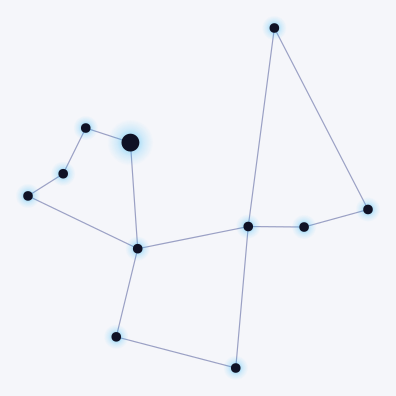
What it looks like
Pavo is a mid-sized southern constellation introduced by Petrus Plancius in 1598, drawn as a peacock. Its brightest star, Alpha Pavonis, was formally named Peacock in 1937 when the Royal Air Force adopted it as a navigation star. The constellation lies in a rich region of the southern sky beside the Small Magellanic Cloud.
Brightest stars
Pavo is anchored by Peacock, a bright blue-white star, with several other stars brighter than magnitude 4.
| Star | Magnitude | Distance | Meaning |
|---|---|---|---|
| Peacock (α Pavonis) | +1.94 | 179 ly | — |
| Beta Pavonis | +3.42 | 135 ly | — |
| Delta Pavonis | +3.56 | 20 ly | — |
| Eta Pavonis | +3.61 | 371 ly | — |
Mythology and history
Pavo has no ancient Greek mythology. It was created in 1598 by Petrus Plancius and named after the peacock, the bird sacred to the goddess Hera.
The peacock of Hera
Pavo was introduced in 1598 by Petrus Plancius, using star positions recorded on Dutch voyages to the East Indies. It was included in Bayer's Uranometria in 1603. Although the constellation itself is modern, the peacock has a rich mythological history: it was sacred to Hera, queen of the gods, and its hundred eyes were said to have come from the giant Argus Panoptes, whom Hera placed in the tail of her favourite bird after his death. The star Peacock formally received its common name in 1937.
How to find it
Look for bright Peacock low in the southern sky on spring and winter evenings, west of the Small Magellanic Cloud.
- Find the Small Magellanic Cloud, then look west for bright Peacock.
- Peacock is one of the brightest stars south of Fomalhaut.
- Best from the southern hemisphere on winter and spring evenings.
Key facts
- Abbreviation
- Pav
- Genitive
- Pavonis
- Meaning
- The Peacock
- Brightest star
- Peacock
- Main stars
- 7
- Area rank
- 44th
- Best visible
- August
- Declination
- -65°
- Meteor showers
- Delta Pavonids
- Neighbours
- Octans, Apus, Ara, Telescopium, Indus, Tucana
Deep-sky objects
NGC 6752 is the third-brightest globular cluster in the sky, visible to the naked eye under dark skies. The constellation also contains the spiral galaxy NGC 6744, a large galaxy often compared to the Milky Way, and the planetary nebula NGC 6818, known as the Little Gem.
Frequently asked questions
What does the constellation Pavo look like?
Pavo is a southern constellation known as the Peacock, marked by its bright star Alpha Pavonis — named 'Peacock' in 1937 — and home to the globular cluster NGC 6752.
What is the brightest star in Pavo?
The brightest star in Pavo is Peacock, shining at around magnitude 1.94.
When is Pavo best visible?
Pavo is best seen from southern hemisphere during August.
What is the story behind Pavo?
Pavo has no ancient Greek mythology. It was created in 1598 by Petrus Plancius and named after the peacock, the bird sacred to the goddess Hera.
Which constellations are near Pavo?
Pavo borders Octans, Apus, Ara, Telescopium, Indus and Tucana.

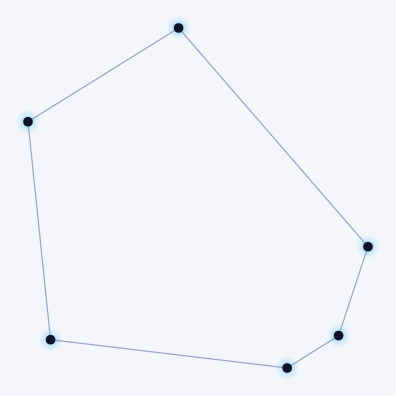 Tucana
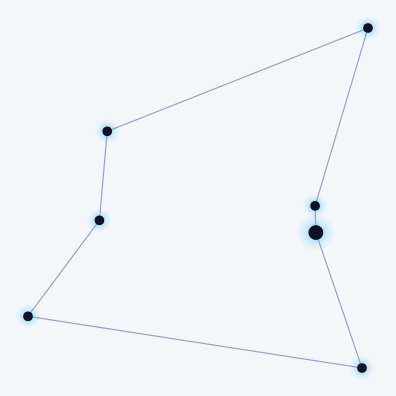 Ara