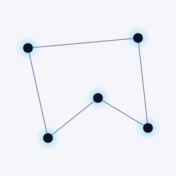
What it looks like
Sextans is a faint equatorial constellation introduced by Johannes Hevelius in 1687, drawn as the sextant he used for his star observations. Its stars are dim — none brighter than magnitude 4.5 — but the constellation lies away from the Milky Way and contains a rich field of distant galaxies. It is unrelated to the Sextant constellation 'Sextans Uraniae', which Hevelius also proposed but was never accepted.
Brightest stars
Sextans has no bright stars; its brightest, Alpha Sextantis, sits near magnitude 4.5.
| Star | Magnitude | Distance | Meaning |
|---|---|---|---|
| Alpha Sextantis | +4.49 | 287 ly | — |
| Gamma Sextantis | +5.05 | 120 ly | — |
| Beta Sextantis | +5.09 | 350 ly | — |
| Delta Sextantis | +5.19 | 300 ly | — |
Mythology and history
Sextans has no ancient mythology. It was created by Hevelius in 1687 and named after the sextant he used to measure star positions, in memory of the instrument destroyed in the fire that consumed his observatory.
The sextant of Hevelius
Sextans was introduced by Johannes Hevelius in his 1687 star atlas, drawn as the sextant he had used for decades to catalogue the positions of stars. In 1679 his observatory in Danzig was destroyed by fire, and the sextant with it. Hevelius commemorated the instrument by placing it in the sky as a constellation. It was the last of the classical instrument constellations to be added, and it remains one of the faintest — a quiet memorial to a lifetime of observation.
How to find it
Look between Leo and Hydra on spring evenings — a small, faint pattern best found with a star chart.
- Find Regulus in Leo, then look south toward Hydra.
- No star brighter than magnitude 4.5 — a true dark-sky object.
- Best on spring evenings from both hemispheres.
Key facts
- Abbreviation
- Sex
- Genitive
- Sextantis
- Meaning
- The Sextant
- Brightest star
- Alpha Sextantis
- Main stars
- 4
- Area rank
- 47th
- Best visible
- April
- Declination
- 0°
- Meteor showers
- —
- Neighbours
- Leo, Hydra, Crater, Corvus
Deep-sky objects
Sextans is rich in faint galaxies, including the Spindle Galaxy (NGC 3115), a bright lenticular galaxy, and the Sextans Dwarf spheroidal galaxy — a very faint satellite of the Milky Way discovered in 1990. The constellation also contains several galaxy groups accessible to moderate telescopes.
Frequently asked questions
What does the constellation Sextans look like?
Sextans is a faint equatorial constellation named for the sextant, introduced by Hevelius in 1687 and lying between Leo and Hydra in a star-poor region.
What is the brightest star in Sextans?
The brightest star in Sextans is Alpha Sextantis, shining at around magnitude 4.49.
When is Sextans best visible?
Sextans is best seen from both hemispheres during April.
What is the story behind Sextans?
Sextans has no ancient mythology. It was created by Hevelius in 1687 and named after the sextant he used to measure star positions, in memory of the instrument destroyed in the fire that consumed his observatory.
Which constellations are near Sextans?
Sextans borders Leo, Hydra, Crater and Corvus.

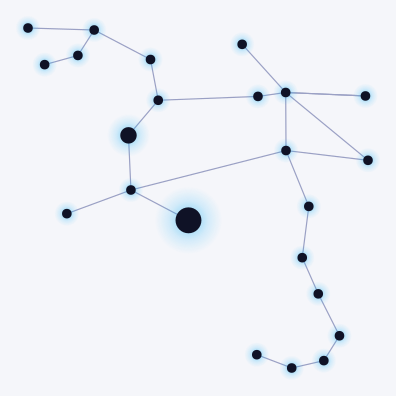 Leo
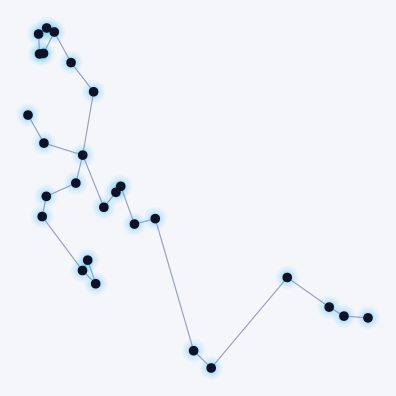 Hydra