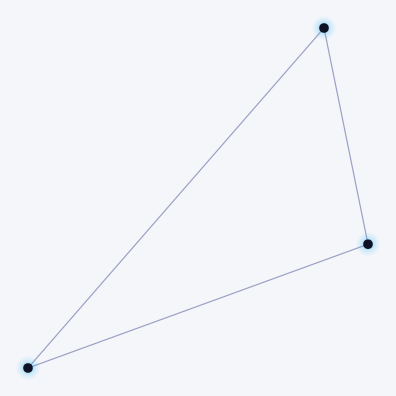
What it looks like
Octans is a mid-sized southern constellation introduced by Lacaille in 1756, drawn as an octant — a navigational instrument that preceded the sextant. It contains the south celestial pole, the point around which the entire southern sky appears to rotate, but unlike the north, there is no bright pole star: Sigma Octantis, at magnitude 5.4, is barely visible to the naked eye.
Brightest stars
Octans has no bright stars; its brightest, Nu Octantis, sits near magnitude 3.7.
| Star | Magnitude | Distance | Meaning |
|---|---|---|---|
| Nu Octantis | +3.73 | 69 ly | — |
| Beta Octantis | +4.13 | 140 ly | — |
| Delta Octantis | +4.31 | 280 ly | — |
| Sigma Octantis | +5.42 | 270 ly | Polaris Australis |
Mythology and history
Octans has no ancient mythology. It was created by Lacaille in 1756 and named after the octant, the navigational instrument he used to measure star positions.
The navigator's octant
Octans was introduced by Lacaille in 1756 and named after the octant, a navigational instrument used to measure the altitudes of celestial bodies at sea. The octant was the predecessor of the sextant, and its invention in the 1730s revolutionised navigation. Lacaille's constellation sits at the southern end of the sky, containing the south celestial pole itself — a fitting home for a navigator's tool, in the region where southern navigators had to work hardest to find their bearings.
How to find it
Use the Southern Cross to locate the south celestial pole, then look within Octans for Sigma Octantis.
- Extend the long axis of the Southern Cross about 4.5 times to reach the pole.
- Sigma Octantis is very faint — much harder than Polaris.
- Best from the southern hemisphere on autumn and winter evenings.
Key facts
- Abbreviation
- Oct
- Genitive
- Octantis
- Meaning
- The Octant
- Brightest star
- Nu Octantis
- Main stars
- 5
- Area rank
- 50th
- Best visible
- October
- Declination
- -85°
- Meteor showers
- —
- Neighbours
- Tucana, Indus, Pavo, Apus, Chamaeleon, Mensa, Hydrus
Deep-sky objects
Octans contains few bright deep-sky objects, but it lies at the south celestial pole and is used to calibrate polar alignment for telescopes in the southern hemisphere. The constellation contains the faint planetary nebula NGC 6300 and several faint galaxies.
Frequently asked questions
What does the constellation Octans look like?
Octans is a faint southern constellation named for the octant, containing the south celestial pole and Sigma Octantis, the very faint southern pole star.
What is the brightest star in Octans?
The brightest star in Octans is Nu Octantis, shining at around magnitude 3.73.
When is Octans best visible?
Octans is best seen from southern hemisphere during October.
What is the story behind Octans?
Octans has no ancient mythology. It was created by Lacaille in 1756 and named after the octant, the navigational instrument he used to measure star positions.
Which constellations are near Octans?
Octans borders Tucana, Indus, Pavo, Apus, Chamaeleon, Mensa and Hydrus.

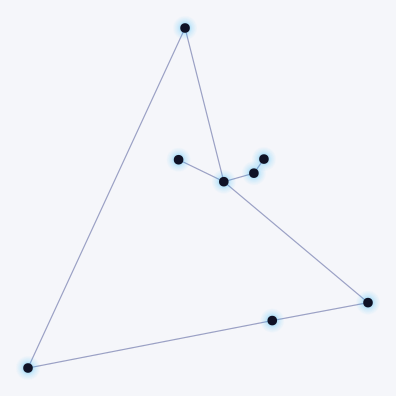 Hydrus
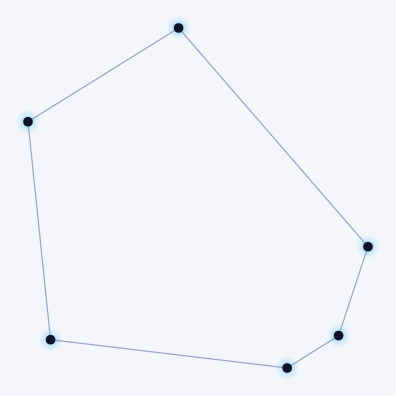 Tucana