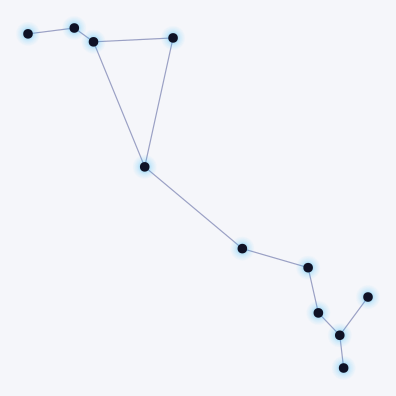
What it looks like
Lynx is a mid-sized northern constellation created by Johannes Hevelius in 1687 to fill the empty region between Ursa Major, Auriga and Gemini. Hevelius chose the name because he joked that only the sharp-eyed lynx could see its faint stars. Its brightest star, Alpha Lyncis, only reaches magnitude 3.1, and the constellation contains several fine double stars and the faint globular cluster NGC 2419.
Brightest stars
Lynx has no bright stars; its brightest, Alpha Lyncis, sits near magnitude 3.1.
| Star | Magnitude | Distance | Meaning |
|---|---|---|---|
| Alpha Lyncis | +3.14 | 203 ly | — |
| 38 Lyncis | +3.82 | 125 ly | — |
| Beta Lyncis | +3.82 | 170 ly | — |
| 15 Lyncis | +4.35 | 170 ly | — |
Mythology and history
Lynx has no ancient mythology. It was created by Hevelius in 1687, and its name is a wry joke about how faint its stars are.
The sharp-eyed cat
Lynx was introduced by Johannes Hevelius in his 1687 star atlas, filling the blank region between Ursa Major, Auriga and Gemini. Hevelius named it after the lynx because, as he put it, only the sharp-eyed lynx could see such faint stars — the ancients had left this part of the sky empty because its stars were too dim to form a figure. The joke is preserved in the constellation's name, and modern observers confirm his wry remark: Lynx has no stars brighter than magnitude 3.1, so it takes good eyes and dark skies to trace it fully.
How to find it
Look between Ursa Major and Gemini on winter and spring evenings — a long, faint line of stars running north-south.
- Find the Big Dipper, then look southeast toward Gemini.
- No bright stars — best under dark skies.
- Best on winter and spring evenings from the northern hemisphere.
Key facts
- Abbreviation
- Lyn
- Genitive
- Lyncis
- Meaning
- The Lynx
- Brightest star
- Alpha Lyncis
- Main stars
- 4
- Area rank
- 28th
- Best visible
- March
- Declination
- +45°
- Meteor showers
- —
- Neighbours
- Ursa Major, Camelopardalis, Auriga, Gemini, Cancer, Leo Minor
Deep-sky objects
Lynx contains the globular cluster NGC 2419 — sometimes called the Intergalactic Wanderer because of its great distance from the Milky Way — plus the spiral galaxy NGC 2683 and the planetary nebula NGC 2534. The constellation also contains the double star 12 Lyncis and the famous 19 Lyncis pair.
Frequently asked questions
What does the constellation Lynx look like?
Lynx is a faint northern constellation introduced by Hevelius in 1687, lying between Ursa Major and Gemini in a star-poor region of the northern sky.
What is the brightest star in Lynx?
The brightest star in Lynx is Alpha Lyncis, shining at around magnitude 3.14.
When is Lynx best visible?
Lynx is best seen from northern hemisphere during March.
What is the story behind Lynx?
Lynx has no ancient mythology. It was created by Hevelius in 1687, and its name is a wry joke about how faint its stars are.
Which constellations are near Lynx?
Lynx borders Ursa Major, Camelopardalis, Auriga, Gemini, Cancer and Leo Minor.

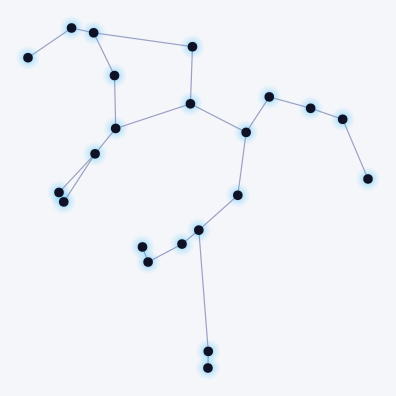 Ursa Major
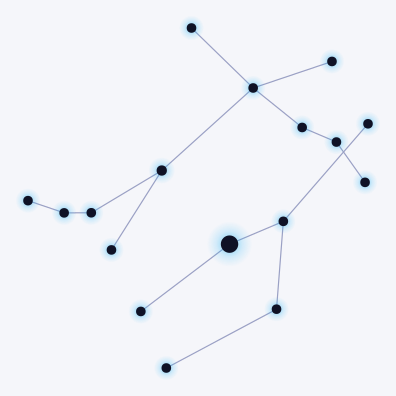 Gemini