
What it looks like
Cassiopeia is a bright northern constellation that lies on the opposite side of Polaris from the Big Dipper. Its five brightest stars form a striking W (or M) asterism, and because it is circumpolar from mid-northern latitudes, it is visible on any clear night.
Brightest stars
Cassiopeia's five brightest stars form the W; Schedar and Caph are the brightest, and the constellation also contains the powerful radio source Cassiopeia A.
| Star | Magnitude | Distance | Meaning |
|---|---|---|---|
| Schedar (α Cassiopeiae) | +2.24 | 228 ly | Breast |
| Caph (β Cassiopeiae) | +2.28 | 55 ly | Palm |
| Gamma Cassiopeiae | +2.47 | 550 ly | — |
| Ruchbah (δ Cassiopeiae) | +2.68 | 99 ly | Knee |
| Segin (ε Cassiopeiae) | +3.35 | 410 ly | — |
Mythology and history
In Greek myth, Cassiopeia was a vain queen who boasted that she and her daughter Andromeda were more beautiful than the Nereids, bringing the wrath of Poseidon on her kingdom.
The boastful queen
Cassiopeia was the wife of King Cepheus of Aethiopia and mother of Andromeda. Her boast that she surpassed the sea-nymphs in beauty so enraged Poseidon that he sent a sea monster, Cetus, to ravage the coast. To appease the god, Andromeda was chained to a rock as a sacrifice — until Perseus rescued her. Cassiopeia was placed in the sky as punishment, and the constellation circles the celestial pole, spending half of every night hanging upside down as an eternal humiliation.
How to find it
Look for the distinctive W of five bright stars opposite the Big Dipper across Polaris, in the northern sky.
- Find Polaris, then look across it from the Big Dipper for the W.
- Circumpolar from mid-northern latitudes — visible year-round.
- Not visible from the southern hemisphere.
Key facts
- Abbreviation
- Cas
- Genitive
- Cassiopeiae
- Meaning
- The Queen
- Brightest star
- Schedar
- Main stars
- 5
- Area rank
- 25th
- Best visible
- November
- Declination
- +60°
- Meteor showers
- Cassiopeiids, Perseids (radiant nearby)
- Neighbours
- Camelopardalis, Cepheus, Lacerta, Andromeda, Perseus
Deep-sky objects
Cassiopeia contains Cassiopeia A, the brightest radio source in the sky outside the solar system and the remnant of a supernova that exploded around 1680. The constellation is also rich in open clusters, including M52 and the Double Cluster (shared with Perseus), and the Pacman Nebula (NGC 281).
Frequently asked questions
What does the constellation Cassiopeia look like?
Cassiopeia is a northern constellation known as the Queen, instantly recognisable by its five brightest stars forming a distinctive W or M shape.
What is the brightest star in Cassiopeia?
The brightest star in Cassiopeia is Schedar, shining at around magnitude 2.24.
When is Cassiopeia best visible?
Cassiopeia is best seen from northern hemisphere during November.
What is the story behind Cassiopeia?
In Greek myth, Cassiopeia was a vain queen who boasted that she and her daughter Andromeda were more beautiful than the Nereids, bringing the wrath of Poseidon on her kingdom.
Which constellations are near Cassiopeia?
Cassiopeia borders Camelopardalis, Cepheus, Lacerta, Andromeda and Perseus.

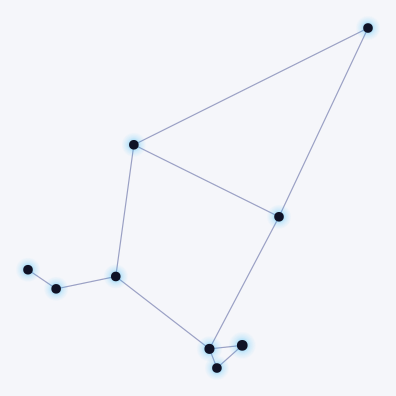 Cepheus
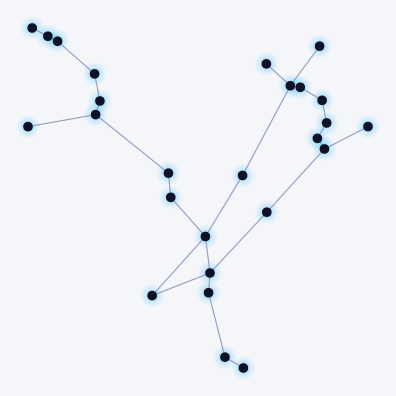 Andromeda