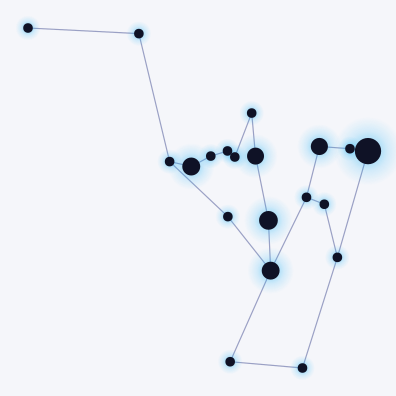
What it looks like
Carina is a bright southern constellation, once part of the ancient Greek figure Argo Navis — the ship of Jason and the Argonauts. When the giant constellation was broken up in 1763, Carina became the ship's keel. It contains Canopus, the second-brightest star in the night sky, and the Carina Nebula, one of the most spectacular star-forming regions visible from Earth.
Brightest stars
Carina is dominated by Canopus, the second-brightest star in the entire night sky, and contains several other bright stars along the Milky Way.
| Star | Magnitude | Distance | Meaning |
|---|---|---|---|
| Canopus (α Carinae) | -0.74 | 310 ly | — |
| Miaplacidus (β Carinae) | +1.67 | 113 ly | — |
| Avior (ε Carinae) | +1.86 | 610 ly | — |
| Aspidiske (ι Carinae) | +2.21 | 690 ly | — |
| Theta Carinae | +2.76 | 460 ly | — |
Mythology and history
Carina was originally part of Argo Navis, the ship that carried Jason and the Argonauts on their quest for the Golden Fleece.
The ship of the Argonauts
Carina represents the keel of Argo Navis, the great ship built by Argus for Jason's quest to retrieve the Golden Fleece from Colchis. The ship was guided by Athena and carried the greatest heroes of Greece: Heracles, Orpheus, Castor, Pollux, Peleus and Telamon among them. After the voyage, the ship was placed in the sky as a reward. Because Argo Navis was so large — nearly 1,900 square degrees — the French astronomer Nicolas-Louis de Lacaille divided it in 1763 into Carina (keel), Puppis (stern) and Vela (sails).
How to find it
Look for brilliant Canopus low in the southern sky on summer evenings — it's the second-brightest star in the night sky after Sirius.
- Canopus is so bright it's used as a spacecraft navigation beacon.
- Look for the Carina Nebula as a bright patch in the Milky Way.
- Best from the southern hemisphere on summer and autumn evenings.
Key facts
- Abbreviation
- Car
- Genitive
- Carinae
- Meaning
- The Keel
- Brightest star
- Canopus
- Main stars
- 9
- Area rank
- 34th
- Best visible
- March
- Declination
- -60°
- Meteor showers
- —
- Neighbours
- Vela, Puppis, Pictor, Volans, Chamaeleon, Musca, Centaurus
Deep-sky objects
The Carina Nebula (NGC 3372) is one of the largest and brightest nebulae in the sky, home to the unstable supergiant Eta Carinae, which may be close to exploding as a supernova. The constellation also contains the Wishing Well Cluster (NGC 3532) and the Southern Pleiades (IC 2602).
Frequently asked questions
What does the constellation Carina look like?
Carina is a large southern constellation known as the Keel, home to brilliant Canopus and the vast Carina Nebula with its unstable star Eta Carinae.
What is the brightest star in Carina?
The brightest star in Carina is Canopus, shining at around magnitude -0.74.
When is Carina best visible?
Carina is best seen from southern hemisphere during March.
What is the story behind Carina?
Carina was originally part of Argo Navis, the ship that carried Jason and the Argonauts on their quest for the Golden Fleece.
Which constellations are near Carina?
Carina borders Vela, Puppis, Pictor, Volans, Chamaeleon, Musca and Centaurus.

 Vela
 Puppis