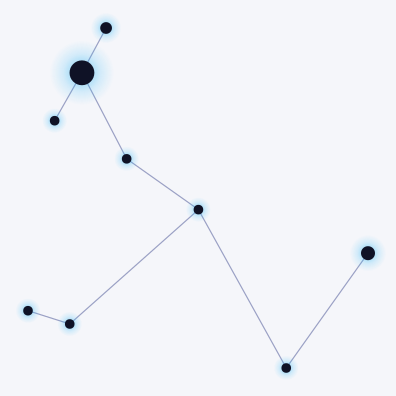
What it looks like
Monoceros is a modern constellation, introduced in 1612 by the Dutch astronomer Petrus Plancius. It is drawn as a unicorn, filling the space between Orion, Canis Major and Canis Minor. Though its stars are faint, the constellation lies along the Milky Way and contains several beautiful nebulae and open clusters.
Brightest stars
Monoceros has no first- or second-magnitude stars; its brightest, Beta Monocerotis, sits near magnitude 3.7 and is a celebrated triple star.
| Star | Magnitude | Distance | Meaning |
|---|---|---|---|
| Beta Monocerotis | +3.76 | 690 ly | — |
| Alpha Monocerotis | +3.94 | 144 ly | — |
| Gamma Monocerotis | +3.99 | 645 ly | — |
| Delta Monocerotis | +4.15 | 384 ly | — |
| Zeta Monocerotis | +4.33 | 680 ly | — |
Mythology and history
Monoceros has no ancient Greek mythology. It was created in the 17th century to fill an empty region of the sky, and the unicorn was chosen as a heraldic symbol rather than a mythological figure.
A modern invention
The unicorn is a creature of medieval European and Near Eastern folklore rather than Greek myth. It was introduced to the sky by Petrus Plancius in 1612, along with several other new constellations, to fill the empty region between Orion and the two dogs. Because there is no ancient tradition attached, Monoceros has no fixed story — but the creature itself appears in medieval bestiaries, heraldry and later in poetry and art, always associated with purity and untameable strength.
How to find it
Look inside the Winter Triangle formed by Sirius, Procyon and Betelgeuse on winter evenings, under dark skies.
- Monoceros fills the empty space inside the Winter Triangle.
- Under dark skies the Milky Way runs through it — a rich binocular region.
- Best on winter evenings from both hemispheres.
Key facts
- Abbreviation
- Mon
- Genitive
- Monocerotis
- Meaning
- The Unicorn
- Brightest star
- Beta Monocerotis
- Main stars
- 4
- Area rank
- 35th
- Best visible
- February
- Declination
- 0°
- Meteor showers
- December Monocerotids, Alpha Monocerotids, June Mu Monocerotids
- Neighbours
- Canis Major, Canis Minor, Gemini, Hydra, Lepus, Orion, Puppis
Deep-sky objects
The Rosette Nebula (NGC 2237) and its central Christmas Tree Cluster (NGC 2264) are the constellation's highlights, plus the Cone Nebula, the Hubble's Variable Nebula, and the open cluster M50. All are within reach of binoculars under dark skies.
Frequently asked questions
What does the constellation Monoceros look like?
Monoceros is a faint equatorial constellation known as the Unicorn, lying between Orion and Canis Major, and home to the Rosette Nebula and the Christmas Tree Cluster.
What is the brightest star in Monoceros?
The brightest star in Monoceros is Beta Monocerotis, shining at around magnitude 3.76.
When is Monoceros best visible?
Monoceros is best seen from both hemispheres during February.
What is the story behind Monoceros?
Monoceros has no ancient Greek mythology. It was created in the 17th century to fill an empty region of the sky, and the unicorn was chosen as a heraldic symbol rather than a mythological figure.
Which constellations are near Monoceros?
Monoceros borders Canis Major, Canis Minor, Gemini, Hydra, Lepus, Orion and Puppis.

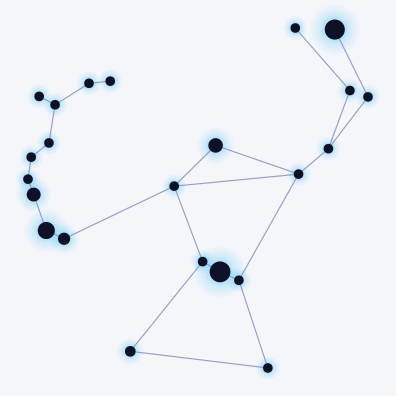 Orion
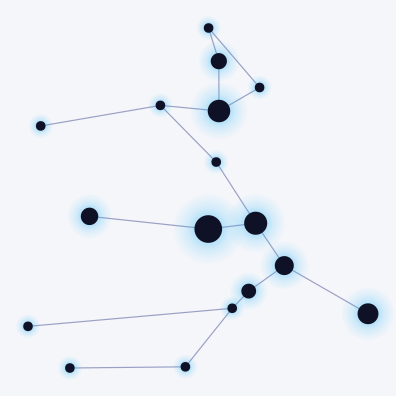 Canis Major