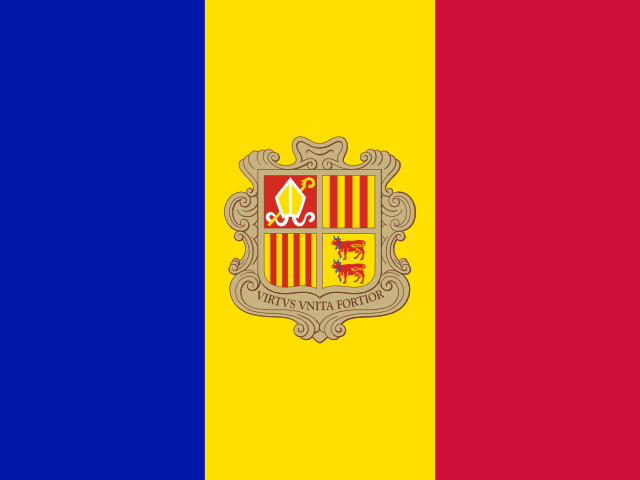
What the flag looks like
The Andorran flag consists of three vertical bands of blue (hoist), yellow (center) and red (fly), with the Andorran coat of arms centered on the yellow band. The yellow band is slightly wider than the blue and red bands. The proportion is 7:10. It was adopted on 27 March 1993, when the Andorran constitution was ratified.
Colors and meaning
The three colors represent the two co-princes of Andorra — the President of France (blue) and the Bishop of Urgell in Spain (yellow and red) — and the historical ties of the principality. The red and yellow also reference the Catalan and Spanish heritage of the region, while the blue references France.
Blue
Represents France, one of Andorra's two co-princes, whose head of state is the President of France. It occupies the hoist band of the flag.
Yellow
Represents the Bishop of Urgell, the other co-prince of Andorra, whose arms include a yellow field. The yellow band is slightly wider than the blue and red bands and holds the coat of arms.
Red
Represents the historical Catalan and Spanish heritage of Andorra and the Bishop of Urgell's coat of arms. Red also represents courage and the blood shed for Andorran independence.
Coat of arms
Features a shield divided into four quarters: the mitre and crozier of the Bishop of Urgell, the three red bars of Foix, the four red bars of Catalonia, and the two cows of Béarn. These represent the historical rulers and regions that have shaped Andorra.
History and adoption
Andorra has been a co-principality since 1278, jointly ruled by the Count of Foix (later the French head of state) and the Bishop of Urgell. The principality used various banners and arms throughout its history, but the modern tricolor was first adopted in 1866 under the co-princes. The design has been refined several times, and the current version was formally adopted on 27 March 1993, when the Andorran constitution was approved by referendum. The coat of arms was also standardized in 1993, and the flag has remained unchanged since.
Key facts
- Adopted
- 27 March 1993
- Proportion
- 7:10
- Designer
- Traditional — based on the arms of the co-princes
- Capital
- Andorra la Vella
- Country code
- AD
- Similar flags
- Moldova, Romania, Chad
Historical and related flags
Andorra has used several flags across its history, reflecting its dual allegiance to France and the Bishop of Urgell.
- Co-principality (1278–1866): Various banners and coats of arms.
- First tricolor (1866–1934): Blue-yellow-red tricolor with an early coat of arms.
- Second design (1934–1939): Variations with modified arms.
- Post-war period (1939–1993): Tricolor with variations of the coat of arms.
- Current flag (1993–present): Standardized tricolor with the current coat of arms.
- Civil flag: Plain tricolor without the coat of arms.
Frequently asked questions
What does the flag of Andorra look like?
The flag of Andorra has three vertical bands of blue (hoist), yellow (center) and red (fly), with the Andorran coat of arms in the center of the yellow band. The proportion is 7:10.
When was the flag of Andorra adopted?
The current flag of Andorra was officially adopted on 27 March 1993.
What do the colors mean?
The three colors represent the two co-princes of Andorra — the President of France (blue) and the Bishop of Urgell in Spain (yellow and red) — and the historical ties of the principality. The red and yellow also reference the Catalan and Spanish heritage of the region, while the blue references France.
Which flags look similar to the Andorra flag?
Moldova, Romania and Chad use the same blue-yellow-red vertical tricolor. Moldova's coat of arms is different, Romania's flag has no emblem, and Chad's blue is darker. Andorra's specific coat of arms with the mitre and cows is unique.

 France
 Spain
 Romania
 Moldova
 Monaco
 Chad