What the flag looks like
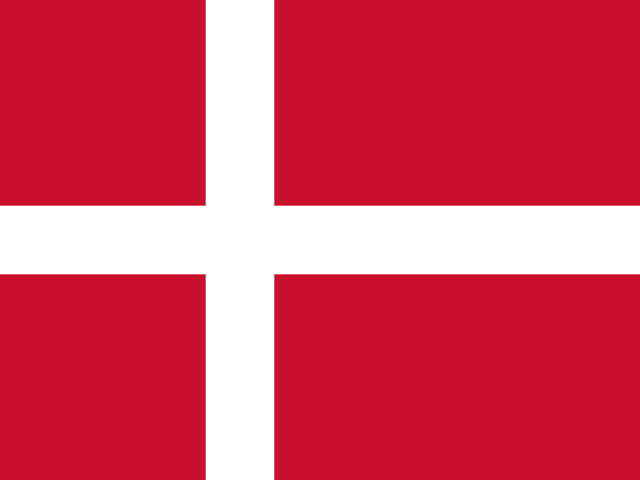
The Danish flag, known as the Dannebrog, consists of a red field bearing a white Nordic cross with the vertical bar offset toward the hoist. The proportion is 28:37 for the national flag, with a swallow-tailed version for the military and royal use. The design has been used since the 14th century, making it the oldest national flag still in use.
Colors and meaning
Red represents courage, strength and the blood shed for the Danish nation, and white represents peace, purity and Christianity. According to legend, the flag fell from the sky during the Battle of Lyndanisse in 1219, giving the Danes victory over the Estonians.
Red
Represents courage, strength and the Danish people. Red has been the field color of the Danish royal arms since the 12th century, featuring a white cross and three blue lions.
White
Represents peace, purity and Christianity. The white cross is one of the earliest Christian symbols used on European banners.
Nordic cross
The cross design, shared with Sweden, Norway, Finland and Iceland, represents Christianity and Nordic unity. The Danish version is the oldest of the group, and the others were derived from it.
Legend of Lyndanisse
According to tradition, the Dannebrog fell from the sky during the Battle of Lyndanisse (modern Tallinn) on 15 June 1219, when the Danes were losing to the Estonians. The flag's appearance was said to give them the strength to win. The date is now celebrated as Valdemar's Day in Denmark.
History and adoption
The Dannebrog has been used by Danish kings since at least the 14th century, and is considered the oldest national flag in continuous use. Its first confirmed depiction is on the Gelre Armorial, a Dutch heraldic manuscript from around 1370. Before that, Danish kings used a banner with a raven or a lion. The flag was used by the Danish navy from the 16th century and by the merchant fleet from the 17th century. It became the official national flag of Denmark in 1854 and was standardized by royal decree in 1893. The proportions were formally set at 28:37 in 1926.
Key facts
- Adopted
- In use since the 14th century (standardized 1854)
- Proportion
- 28:37
- Designer
- Traditional — associated with King Valdemar II
- Capital
- Copenhagen
- Country code
- DK
- Similar flags
- Sweden, Norway, Finland, Iceland
Historical and related flags
Denmark uses several official flag variants, and the Dannebrog has been used on Danish ships and buildings for centuries.
- Royal standard: Red field with the Danish royal arms.
- State flag: Swallow-tailed version with a white cross, used on government buildings.
- Naval ensign: Swallow-tailed with a white cross, used by the Royal Danish Navy.
- Merchant flag: Rectangular with a white cross, used on Danish ships.
- Dannebrog with split: Used on Danish military installations and ships.
- Greenland and Faroe Islands: Use their own flags, but remain part of the Danish realm.
Frequently asked questions
What does the flag of Denmark look like?
The flag of Denmark is a red field with a white Nordic cross that extends to the edges of the flag, with the vertical bar offset toward the hoist. The proportion is 28:37.
When was the flag of Denmark adopted?
The current flag of Denmark was officially adopted on In use since the 14th century (standardized 1854).
What do the colors mean?
Red represents courage, strength and the blood shed for the Danish nation, and white represents peace, purity and Christianity. According to legend, the flag fell from the sky during the Battle of Lyndanisse in 1219, giving the Danes victory over the Estonians.
Which flags look similar to the Denmark flag?
All Nordic countries use the Nordic cross. Sweden uses blue with a yellow cross, Norway uses red with a blue-and-white cross, Finland uses white with a blue cross, and Iceland uses blue with a red-and-white cross. Denmark's red field with a plain white cross is the original design that inspired the others.

 Sweden
 Norway
 Finland
 Iceland
 Germany
 Switzerland