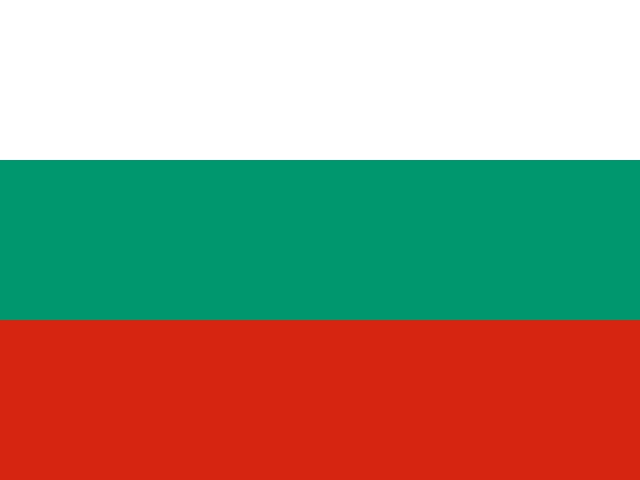
What the flag looks like
The Bulgarian flag consists of three equal horizontal bands of white (top), green (middle) and red (bottom). The proportion is 3:5. It was readopted on 27 November 1990, after the fall of the communist government, removing the state emblem that had been in the upper-left corner since 1948. The plain tricolor itself dates back to 1879.
Colors and meaning
White represents peace, love and freedom, green represents the fertility of the Bulgarian land and its forests and agriculture, and red represents the courage and blood of the Bulgarian people shed in the struggle for independence. The colors are derived from the flag of the Bulgarian Legion, a volunteer force that fought against the Ottoman Empire in the 1860s.
White
Represents peace, love, freedom and the white of the Bulgarian landscape in winter.
Green
Represents the fertility of the Bulgarian land, its forests, agriculture and natural wealth. Bulgaria is one of the largest producers of rose oil in the world.
Red
Represents the courage of the Bulgarian people and the blood shed during the long struggle for independence from the Ottoman Empire, which lasted from 1396 to 1878.
Origin
The white-green-red tricolor was first used by the Bulgarian Legion in 1862, a volunteer force that fought alongside Serbian and Russian forces against the Ottomans. It was inspired by the Russian flag and adapted by Bulgarian revolutionaries.
History and adoption
The Bulgarian tricolor was first used by the Bulgarian Legion in 1862 during the struggle against Ottoman rule, and was formalized by the Bulgarian revolutionary committee in 1867. After Bulgaria gained autonomy in 1878 following the Russo-Turkish War, the white-green-red tricolor was adopted as the national flag on 16 April 1879. From 1948 to 1990, the communist government added a state emblem in the upper-left corner featuring a lion, wheat sheaves and a red star. The plain tricolor was restored on 27 November 1990, following the fall of communism, and has remained unchanged since.
Key facts
- Adopted
- 27 November 1990
- Proportion
- 3:5
- Designer
- Traditional — derived from the Bulgarian Legion's flag
- Capital
- Sofia
- Country code
- BG
- Similar flags
- Hungary, Iran
Historical and related flags
Bulgaria has used several national flags across its monarchic, communist and post-communist periods.
- Bulgarian Legion (1862): First white-green-red tricolor used by revolutionaries.
- Principality of Bulgaria (1879–1908): Plain tricolor adopted as the national flag.
- Kingdom of Bulgaria (1908–1946): Tricolor with the royal coat of arms in the center.
- People's Republic of Bulgaria (1948–1967): Tricolor with a state emblem in the upper-left corner.
- Socialist Bulgaria (1967–1990): Same design with a modified state emblem.
- Current flag (1990–present): Plain white-green-red tricolor.
Frequently asked questions
What does the flag of Bulgaria look like?
The flag of Bulgaria has three equal horizontal bands of white (top), green (middle) and red (bottom). The proportion is 3:5.
When was the flag of Bulgaria adopted?
The current flag of Bulgaria was officially adopted on 27 November 1990.
What do the colors mean?
White represents peace, love and freedom, green represents the fertility of the Bulgarian land and its forests and agriculture, and red represents the courage and blood of the Bulgarian people shed in the struggle for independence. The colors are derived from the flag of the Bulgarian Legion, a volunteer force that fought against the Ottoman Empire in the 1860s.
Which flags look similar to the Bulgaria flag?
Hungary uses red-white-green horizontal bands — the reverse of Bulgaria's white-green-red. Iran uses green-white-red with a central emblem. Bulgaria's white-green-red tricolor is unique among national flags.

 Romania
 Hungary
 Greece
 Turkey
 Serbia
 North Macedonia