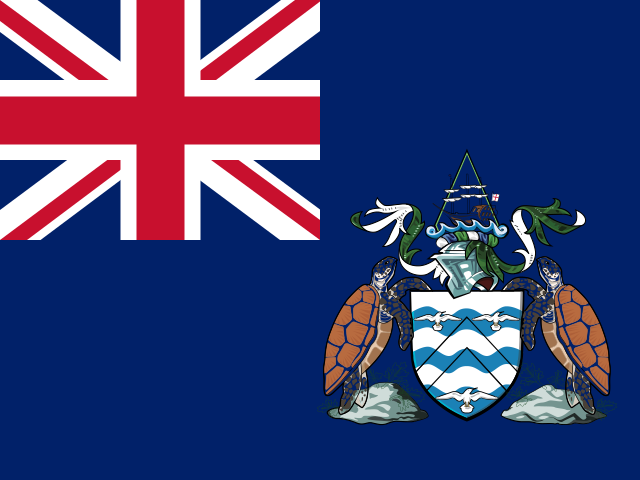
What the flag looks like
Saint Helena, Ascension and Tristan da Cunha is a British Overseas Territory in the South Atlantic Ocean, made up of three widely separated island groups. The territory as a whole does not have a single flag — the Union Jack is used officially for the territory. Each of the three constituent parts has its own flag based on the British Blue Ensign, with a unique coat of arms or shield in the fly. The flag of Saint Helena shows a shield with a ship, cliffs and a wirebird; the flag of Ascension Island shows a shield with a ship, turtles and seabirds; and the flag of Tristan da Cunha shows a shield with a longboat, a Tristan rock lobster and a volcano.
Colors and meaning
The blue field of each Blue Ensign represents the Atlantic Ocean that surrounds the islands, the Union Jack in the canton represents the territory's status as a British Overseas Territory, and the shield in the fly represents the unique identity of each island group — its wildlife, geography and history.
Union Jack
Represents the territory's constitutional status as a British Overseas Territory. The Union Jack appears in the upper hoist canton of each of the three island flags and is used officially for the territory as a whole.
Blue field
Represents the South Atlantic Ocean that surrounds the three island groups. The blue field is the traditional color of British colonial and overseas territory flags.
Saint Helena shield
Features a ship (the East Indiaman 'Windsor Castle' arriving at the island), the cliffs of Saint Helena and a Saint Helena plover — known locally as the wirebird, which is the national bird and one of the world's rarest birds.
Ascension Island shield
Features a ship, three green turtles (the island is a major nesting ground for the green sea turtle) and two seabirds — the sooty tern (locally called 'wideawake') and the frigatebird, both of which nest on the island.
Tristan da Cunha shield
Features a longboat (the traditional wooden boat used by islanders to travel between the islands), a Tristan rock lobster (the island's main export) and a volcano (the island of Tristan da Cunha is itself a volcano — Queen Mary's Peak, the highest point in the territory).
History and adoption
Saint Helena has been a British territory since 1659 and was administered by the British East India Company for much of its early history. Ascension Island was claimed by Britain in 1815 and became part of the territory in 1922, and Tristan da Cunha became a dependency in 1938. The three parts were administered together as a single colony from 2009 under a new constitution. Saint Helena adopted its Blue Ensign flag in 1984, Ascension Island in 2013, and Tristan da Cunha in 2002. Before 2013, Ascension Island used the Saint Helena flag. There is no combined flag for the whole territory — the Union Jack is used for official purposes when a single flag is needed. Each island flag is used locally within its own jurisdiction.
Key facts
- Adopted
- Saint Helena: 1984; Tristan da Cunha: 2002; Ascension Island: 2013
- Proportion
- 1:2
- Designer
- Each island's flag is based on the British Blue Ensign with a distinctive shield
- Capital
- Jamestown (Saint Helena)
- Country code
- SH-AC
- Similar flags
- Other British Overseas Territories
Historical and related flags
Saint Helena, Ascension and Tristan da Cunha has used several flags across its history, and each island has its own flag today.
- British East India Company (1659–1834): Company flag used during the East India Company's administration of Saint Helena.
- British colony (1834–1984): British Union Jack and colonial flags used.
- Saint Helena flag (1984–present): Blue Ensign with the Saint Helena shield.
- Tristan da Cunha flag (2002–present): Blue Ensign with the Tristan da Cunha shield.
- Ascension Island flag (2013–present): Blue Ensign with the Ascension Island shield.
Frequently asked questions
What does the flag of Saint Helena, Ascension and Tristan da Cunha look like?
Saint Helena, Ascension and Tristan da Cunha has no single official flag. The Union Jack is used for the territory as a whole, while each of the three constituent parts — Saint Helena, Ascension Island and Tristan da Cunha — has its own Blue Ensign flag with a distinctive shield in the fly.
When was the flag of Saint Helena, Ascension and Tristan da Cunha adopted?
The current flag of Saint Helena, Ascension and Tristan da Cunha was officially adopted on Saint Helena: 1984; Tristan da Cunha: 2002; Ascension Island: 2013.
What do the colors mean?
The blue field of each Blue Ensign represents the Atlantic Ocean that surrounds the islands, the Union Jack in the canton represents the territory's status as a British Overseas Territory, and the shield in the fly represents the unique identity of each island group — its wildlife, geography and history.
Which flags look similar to the Saint Helena, Ascension and Tristan da Cunha flag?
Saint Helena, Ascension and Tristan da Cunha's flags are similar to those of other British Overseas Territories (such as the Falkland Islands, Montserrat, the British Virgin Islands and the Cayman Islands), all of which use the British Blue Ensign with a distinctive shield in the fly.

 United Kingdom
 Falkland Islands
 Montserrat
 British Virgin Islands
 Cayman Islands
 South Africa