What the flag looks like
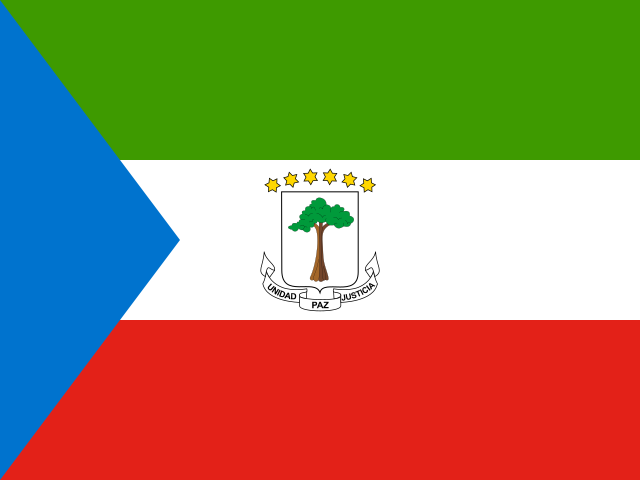
The flag of Equatorial Guinea consists of three equal horizontal bands of green (top), white (middle) and red (bottom), with a blue isosceles triangle at the hoist side. The national coat of arms appears in the center of the white band — a grey shield with a silk-cotton tree and six six-pointed stars, with the motto 'Unidad, Paz, Justicia' below. The proportion is 2:3. It was adopted on 21 August 1979.
Colors and meaning
Green represents the lush vegetation and jungles of the mainland, white represents peace, red represents the blood shed for independence, and blue represents the Atlantic Ocean that surrounds the country's islands and coastline. The silk-cotton tree on the coat of arms represents the tree under which the first treaty between Spain and a local king was signed.
Green
Represents the lush tropical vegetation and dense jungles of Río Muni, the mainland portion of Equatorial Guinea, and the country's agricultural wealth.
White
Represents peace and the desire for peaceful development. It is the middle band and the background for the national coat of arms.
Red
Represents the blood shed by Equatorial Guinean patriots in the struggle for independence from Spain, achieved in 1968, and the determination of the people.
Blue triangle
Represents the Atlantic Ocean, which surrounds Equatorial Guinea's islands — Bioko and Annobón — and borders the mainland coast. Blue also represents the connection between the island and mainland portions of the country.
Coat of arms
Features a grey shield with a silk-cotton tree (the tree under which the first treaty between Spain and a local king was signed in the 18th century), six six-pointed stars representing the mainland and the five islands, and the motto 'Unidad, Paz, Justicia' (Unity, Peace, Justice) below.
History and adoption
Equatorial Guinea was a Spanish colony from 1778 until 1968, when it gained independence on 12 October 1968. The first national flag, adopted at independence, had green, white and red horizontal bands with a blue triangle at the hoist and the coat of arms in the center. In 1972, under President Francisco Macías Nguema, the flag was modified — the coat of arms was removed, and later the flag was altered to include a hammer and sickle during the country's brief period of Marxist-Leninist alignment. After Macías was overthrown in 1979, the current flag was adopted on 21 August 1979, restoring the original design with the coat of arms. It has remained unchanged since.
Key facts
- Adopted
- 21 August 1979
- Proportion
- 2:3
- Designer
- Based on the 1968 independence flag
- Capital
- Malabo
- Country code
- GQ
- Similar flags
- None
Historical and related flags
Equatorial Guinea has used several flags since its independence from Spain.
- Spanish Guinea (1778–1968): Spanish flag used during colonial rule.
- First flag (1968–1972): Green-white-red with blue triangle and coat of arms.
- Macías period (1972–1979): Variants including a version with a hammer and sickle.
- Current flag (1979–present): Original design restored with the current coat of arms.
- Presidential standard: Uses the national coat of arms on a distinct field.
Frequently asked questions
What does the flag of Equatorial Guinea look like?
The flag of Equatorial Guinea has three horizontal bands of green (top), white (middle) and red (bottom), with a blue isosceles triangle at the hoist and the national coat of arms in the center of the white band. The proportion is 2:3.
When was the flag of Equatorial Guinea adopted?
The current flag of Equatorial Guinea was officially adopted on 21 August 1979.
What do the colors mean?
Green represents the lush vegetation and jungles of the mainland, white represents peace, red represents the blood shed for independence, and blue represents the Atlantic Ocean that surrounds the country's islands and coastline. The silk-cotton tree on the coat of arms represents the tree under which the first treaty between Spain and a local king was signed.
Which flags look similar to the Equatorial Guinea flag?
No other national flag closely resembles Equatorial Guinea's. The combination of green, white and red bands with a blue triangle and a central coat of arms is unique.

 Gabon
 Cameroon
 São Tomé and Príncipe
 Nigeria
 Mozambique
 Cuba