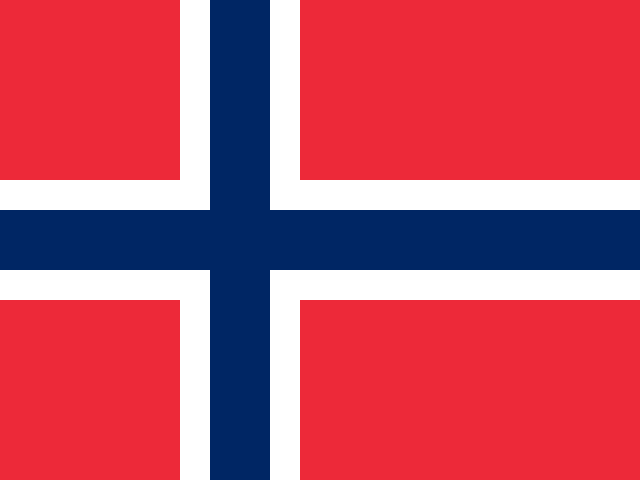
What the flag looks like
The Norwegian flag consists of a red field bearing a blue Nordic cross with a white border. The vertical bar of the cross is offset toward the hoist, following the Nordic tradition. The proportion is 8:11 for the national flag, with a swallow-tailed version for the military. It was designed in 1821 by Fredrik Meltzer and formally adopted on 13 July 1821.
Colors and meaning
The colors reference Norway's historical ties to Denmark (red and white) and Sweden (blue), combined into a single flag that asserted Norwegian identity. Red represents courage and the blood shed for the nation, white represents peace and purity, and blue represents loyalty, justice and the sea.
Red
Inherited from the Danish Dannebrog, which Norway used for centuries as part of the Denmark–Norway union. Represents courage and the blood shed for Norwegian independence.
White
Also inherited from the Danish flag, representing peace and purity.
Blue
Added by designer Fredrik Meltzer to represent Norway's liberal ideals and its historical link to Sweden. Represents loyalty, justice and Norway's maritime tradition.
Nordic cross
The cross design is shared with Denmark, Sweden, Finland and Iceland, representing Christianity and Nordic unity.
History and adoption
Norway was in a union with Denmark from 1380 to 1814 and with Sweden from 1814 to 1905. During the Swedish union, Norway used the Swedish flag with a Norwegian emblem in the canton. In 1821, while still in union with Sweden, the Norwegian parliament adopted a new design by Fredrik Meltzer — a red field with a blue cross bordered in white. The flag was used on Norwegian ships and gradually became the national flag. After Norway gained full independence in 1905, the current flag was formally confirmed in law on 13 July 1821 (retroactively confirmed in 1898 for merchant use). The proportions were standardized in 1906.
Key facts
- Adopted
- 13 July 1821
- Proportion
- 8:11
- Designer
- Fredrik Meltzer
- Capital
- Oslo
- Country code
- NO
- Similar flags
- Denmark, Sweden, Finland, Iceland
Historical and related flags
Norway has used several flag designs across its union with Denmark and Sweden, and today uses several official variants.
- Denmark–Norway (1536–1814): The Danish Dannebrog used as the shared flag.
- Union with Sweden (1814–1821): Swedish flag with a Norwegian emblem in the canton.
- Norwegian flag (1821–1844): Meltzer's design used on Norwegian ships.
- Union mark (1844–1899): Both flags featured a combined 'herring salad' canton.
- Current flag (1899–present): Plain Norwegian design without the union mark.
- Royal standard: Red field with the Norwegian lion and crown.
Frequently asked questions
What does the flag of Norway look like?
The flag of Norway is a red field with a blue Nordic cross that is bordered in white. The proportion is 8:11.
When was the flag of Norway adopted?
The current flag of Norway was officially adopted on 13 July 1821.
What do the colors mean?
The colors reference Norway's historical ties to Denmark (red and white) and Sweden (blue), combined into a single flag that asserted Norwegian identity. Red represents courage and the blood shed for the nation, white represents peace and purity, and blue represents loyalty, justice and the sea.
Which flags look similar to the Norway flag?
Denmark uses a red field with a plain white cross. Sweden uses a blue field with a yellow cross. Finland uses a white field with a blue cross. Iceland uses a blue field with a red cross bordered in white. Norway's red field with a blue cross bordered in white is unique.

 Sweden
 Denmark
 Finland
 Iceland
 Thailand
 Netherlands