What the flag looks like
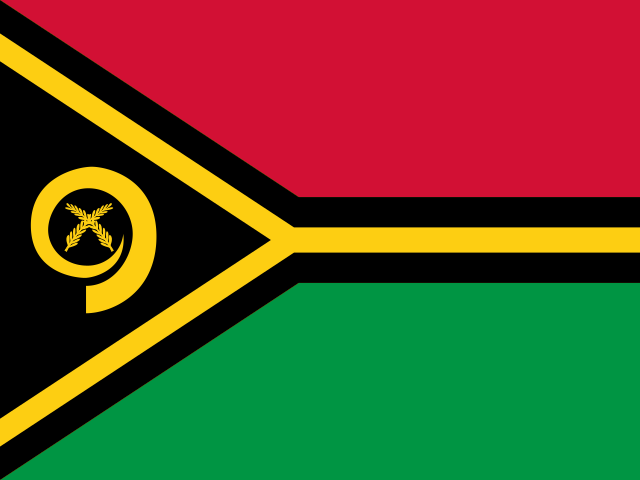
The Vanuatuan flag consists of two horizontal bands — red (top) and green (bottom) — separated by a black horizontal stripe edged in yellow. A black triangle at the hoist contains a golden boar's tusk and two namele fern leaves, both curved in a circular shape. The proportion is 19:36. It was adopted on 18 February 1980, when Vanuatu gained independence from Britain and France.
Colors and meaning
Red represents the blood shed during the struggle for independence and the brotherhood of the Ni-Vanuatu people, green represents the islands' fertile land and agricultural wealth, black represents the Melanesian people of Vanuatu, and yellow represents the light of Christianity and peace. The boar's tusk represents prosperity and wealth in traditional Vanuatuan culture, and the namele leaves represent peace.
Red
Represents the blood shed during the long struggle for independence, and the brotherhood and unity of the Ni-Vanuatu people. Red is also associated with the political movement that led Vanuatu to independence.
Green
Represents the fertile land and agricultural wealth of Vanuatu — the islands are known for their copra, cocoa, coffee and beef production, as well as their lush tropical vegetation.
Black
Represents the Melanesian people of Vanuatu, who make up the vast majority of the country's population. Black is a common Pan-Melanesian color used by many Pacific island nations.
Yellow
Represents the light of Christianity and peace. Christianity is the dominant religion of Vanuatu, introduced by European missionaries in the 19th century.
Boar's tusk
The golden boar's tusk in the black hoist triangle represents prosperity and wealth in traditional Vanuatuan culture. Circular boar's tusks were — and remain — one of the most valuable items in traditional Ni-Vanuatu society, used in ceremonies, as bride price and as a store of value.
Namele leaves
The two namele fern leaves are a traditional symbol of peace. In Vanuatuan culture, namele leaves are used to signal a sacred peace — they are placed at the entrance to villages and on paths to indicate a peace agreement. Together with the boar's tusk, they form a symbol that represents the core values of Vanuatuan society: prosperity and peace.
History and adoption
Vanuatu was jointly administered by Britain and France as the New Hebrides from 1906 until 1980, making it one of the only condominiums in modern history. The independence movement, led by the Vanua'aku Pati, adopted a flag during the 1970s that featured red, green and black bands with the boar's tusk and namele leaves. When Vanuatu gained independence on 30 July 1980, this design was formalized as the national flag. The flag was adopted on 18 February 1980, and has remained unchanged since.
Key facts
- Adopted
- 18 February 1980
- Proportion
- 19:36
- Designer
- Based on the flag of the Vanua'aku Pati
- Capital
- Port Vila
- Country code
- VU
- Similar flags
- None
Historical and related flags
Vanuatu used several flags during its Anglo-French condominium period before independence.
- New Hebrides (1906–1980): Joint British and French flags used during the condominium period.
- Vanua'aku Pati flag (1970s–1980): Precursor design used by the independence movement.
- Current flag (1980–present): Red, green, black and yellow with boar's tusk and namele leaves.
- Presidential standard: Uses the Vanuatuan coat of arms with a Melanesian warrior and a boar's tusk.
Frequently asked questions
What does the flag of Vanuatu look like?
The flag of Vanuatu is divided horizontally into red (top) and green (bottom) bands by a black horizontal stripe edged in yellow, with a black hoist triangle containing a golden boar's tusk and two namele fern leaves. The proportion is 19:36.
When was the flag of Vanuatu adopted?
The current flag of Vanuatu was officially adopted on 18 February 1980.
What do the colors mean?
Red represents the blood shed during the struggle for independence and the brotherhood of the Ni-Vanuatu people, green represents the islands' fertile land and agricultural wealth, black represents the Melanesian people of Vanuatu, and yellow represents the light of Christianity and peace. The boar's tusk represents prosperity and wealth in traditional Vanuatuan culture, and the namele leaves represent peace.
Which flags look similar to the Vanuatu flag?
No other national flag closely resembles Vanuatu's. The combination of red, green, black and yellow with a boar's tusk and namele leaves is unique.

 Fiji
 Solomon Islands
 Papua New Guinea
 Samoa
 Tonga
 Australia