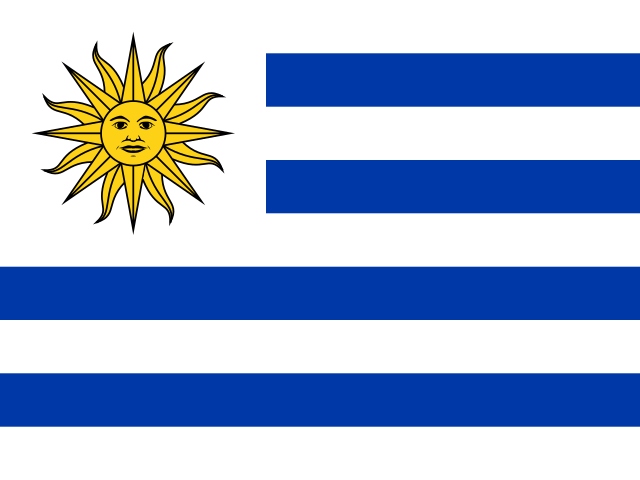
What the flag looks like
The Uruguayan flag consists of nine equal horizontal stripes of white and blue, alternating with white at the top and bottom, and a white square canton in the upper hoist corner bearing a golden Sun of May with 16 rays. The proportion is 2:3. It was adopted on 11 July 1830 and has remained unchanged since, making it one of the oldest national flags in South America.
Colors and meaning
Blue and white represent the sky and the waters of the Río de la Plata, and the colors were also the traditional colors of the Argentine independence movement, to which Uruguay was once linked. The golden Sun of May represents the May Revolution of 1810 and the birth of Uruguayan independence.
Blue
Represents the sky and the Río de la Plata, the estuary that separates Uruguay from Argentina. Blue is also one of the historic colors of the Argentine and Uruguayan independence movements.
White
Represents peace, purity and the clouds over the Río de la Plata. It alternates with blue in the nine stripes.
Nine stripes
Represent the nine original departments of Uruguay: Montevideo, Canelones, San José, Colonia, Soriano, Paysandú, Cerro Largo, Durazno and Maldonado.
Sun of May
A golden sun with 16 rays — eight straight and eight wavy — bearing a face in the center. It commemorates the May Revolution of 25 May 1810 in Buenos Aires, which began the independence movement in the Río de la Plata region.
History and adoption
Uruguay declared independence from Brazil in 1825 and from the United Provinces of the Río de la Plata in 1828. The first Uruguayan flag, adopted in 1828, had 19 stripes of blue and white with a red canton. In 1830, the number of stripes was reduced to nine, and the red canton was replaced with the white canton bearing the Sun of May. This design was officially adopted on 11 July 1830, and has remained unchanged ever since, despite many political upheavals in the country's history. Uruguay's flag is one of the oldest in continuous use in the Americas.
Key facts
- Adopted
- 11 July 1830
- Proportion
- 2:3
- Designer
- Joaquín Suárez (design)
- Capital
- Montevideo
- Country code
- UY
- Similar flags
- Greece, Argentina
Historical and related flags
Uruguay has used several flags since independence, with the number of stripes and the emblem changing over the years.
- First flag (1825–1828): Blue-white-blue triband with a red canton.
- Second flag (1828–1830): 19 stripes of blue and white with the Sun of May in the canton.
- Current flag (1830–present): Nine stripes with the Sun of May in the canton.
- Presidential standard: The flag with the Uruguayan coat of arms in the center.
- Artigas flag: Historic federalist flag of the Liga Federal, used by José Gervasio Artigas.
Frequently asked questions
What does the flag of Uruguay look like?
The flag of Uruguay has nine horizontal stripes of white and blue, with a white canton in the upper hoist corner bearing the golden Sun of May. The proportion is 2:3.
When was the flag of Uruguay adopted?
The current flag of Uruguay was officially adopted on 11 July 1830.
What do the colors mean?
Blue and white represent the sky and the waters of the Río de la Plata, and the colors were also the traditional colors of the Argentine independence movement, to which Uruguay was once linked. The golden Sun of May represents the May Revolution of 1810 and the birth of Uruguayan independence.
Which flags look similar to the Uruguay flag?
Greece uses nine blue and white stripes with a cross in the canton. Argentina uses three horizontal bands with the Sun of May. Uruguay combines the striped design of Greece with the Sun of May of Argentina, making it visually unique.

 Argentina
 Brazil
 Paraguay
 Chile
 Greece
 Bolivia