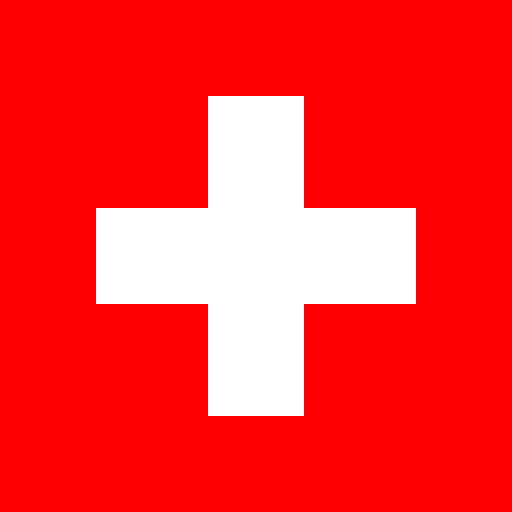
What the flag looks like
The Swiss flag is a red square with a white, equal-armed cross in the center. The arms of the cross are one-sixth longer than they are wide, and the cross does not touch the edges of the square. The flag proportion is 1:1, making it one of only two square national flags in the world. The merchant flag used at sea is rectangular (2:3).
Colors and meaning
Red represents the blood shed for Swiss independence and is derived from the coat of arms of Schwyz, one of the founding cantons. White represents peace, honesty and the Christian heritage of the confederation.
Red
Derived from the red banner of Schwyz, one of the three founding cantons of the Swiss Confederacy. Represents strength, courage and the blood shed for independence.
White
Represents peace, purity and the Christian heritage of the Swiss Confederacy. The white cross has been used as a field sign since the 14th century.
The cross
A Greek cross with arms of equal length, symbolizing the Christian faith and the unity of the cantons. The design dates back to the Battle of Laupen in 1339, when Swiss soldiers sewed white crosses onto their clothing to distinguish themselves.
History and adoption
The white cross on a red field has been a symbol of the Swiss Confederacy since the 14th century. It was first used as a field sign by Swiss soldiers at the Battle of Laupen in 1339, and became a common emblem of the confederation over the following centuries. The modern square design was formalized by the Federal Council on 12 December 1889, making it the official national flag of Switzerland. A rectangular version (2:3) is used as the Swiss merchant flag at sea.
Key facts
- Adopted
- 12 December 1889
- Proportion
- 1:1
- Designer
- Traditional design formalized by the Federal Council
- Capital
- Bern
- Country code
- CH
- Similar flags
- Denmark
Historical and related flags
The Swiss flag has evolved over centuries from a battlefield field sign into a formal national symbol.
- Battlefield cross (1339): First documented use at the Battle of Laupen.
- Confederate field sign (15th–18th century): Worn on clothing by Swiss soldiers.
- Helvetic Republic (1798–1803): A green-red-yellow tricolor briefly replaced the cross.
- Modern square flag (1889–present): Formalized by the Federal Council.
- Swiss merchant flag (2:3): Rectangular version for use at sea.
Frequently asked questions
What does the flag of Switzerland look like?
The flag of Switzerland is a red square with a white cross in the center. The cross has arms of equal length, each one-sixth longer than they are wide. It is one of only two square national flags in the world, along with Vatican City.
When was the flag of Switzerland adopted?
The current flag of Switzerland was officially adopted on 12 December 1889.
What do the colors mean?
Red represents the blood shed for Swiss independence and is derived from the coat of arms of Schwyz, one of the founding cantons. White represents peace, honesty and the Christian heritage of the confederation.
Which flags look similar to the Switzerland flag?
Denmark also uses a white cross on red, but the Danish cross is an off-center Nordic cross that extends to the edges of the flag, while the Swiss cross is centered and does not touch the edges.

 Denmark
 Austria
 Germany
 Italy
 France
 Vatican City