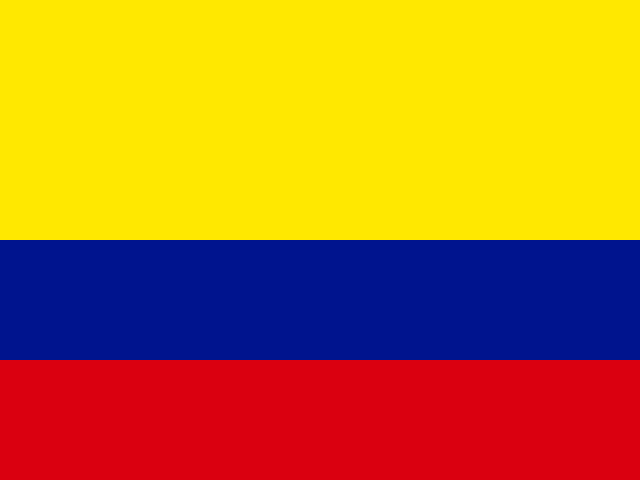
What the flag looks like
The Colombian flag consists of three horizontal bands: yellow on the top half, and blue and red each on a quarter of the width. The proportion is 2:3. It was adopted on 26 November 1861 and is derived from the flag of Gran Colombia, the short-lived republic that included present-day Colombia, Venezuela, Ecuador and Panama.
Colors and meaning
Yellow represents the wealth and natural resources of Colombia, blue represents the two oceans that border the country (the Atlantic and Pacific) and its rivers, and red represents the blood shed by Colombian patriots in the struggle for independence.
Yellow
Represents the gold, wealth and natural resources of Colombia, and the sun that shines over the country. It occupies the top half of the flag.
Blue
Represents the two oceans that border Colombia — the Atlantic to the north and the Pacific to the west — and the many rivers that cross the country.
Red
Represents the blood shed by Colombian patriots during the long struggle for independence from Spain, achieved in 1819 at the Battle of Boyacá.
Origin
The colors date back to the flag of Gran Colombia (1819–1831), designed by Francisco de Miranda, which combined yellow, blue and red in horizontal bands. Colombia, Venezuela and Ecuador all use variants of this design.
History and adoption
The Colombian flag's origins trace to Francisco de Miranda's 1806 flag for a unified South American state, which combined yellow, blue and red. The design was used by Gran Colombia — the republic founded in 1819 that included present-day Colombia, Venezuela, Ecuador and Panama — with the yellow band originally equal in width. After Gran Colombia dissolved in 1831, Colombia (then called New Granada) continued to use variants. The current design, with a wider yellow band, was adopted on 26 November 1861 during the presidency of Tomás Cipriano de Mosquera. It has remained unchanged since.
Key facts
- Adopted
- 26 November 1861
- Proportion
- 2:3
- Designer
- Francisco de Miranda (original colors)
- Capital
- Bogotá
- Country code
- CO
- Similar flags
- Ecuador, Venezuela
Historical and related flags
Colombia has used several flags since independence, most of them derived from Francisco de Miranda's original design.
- Gran Colombia (1819–1831): Yellow-blue-red tricolor with equal bands.
- New Granada (1831–1858): Tricolor with a coat of arms in the center.
- Granadine Confederation (1858–1861): Tricolor with a different coat of arms.
- United States of New Granada (1861): Tricolor without emblem.
- Current flag (1861–present): Yellow (half), blue (quarter), red (quarter).
Frequently asked questions
What does the flag of Colombia look like?
The flag of Colombia has three horizontal bands of yellow (top, half the width), blue (quarter) and red (quarter). The proportion is 2:3.
When was the flag of Colombia adopted?
The current flag of Colombia was officially adopted on 26 November 1861.
What do the colors mean?
Yellow represents the wealth and natural resources of Colombia, blue represents the two oceans that border the country (the Atlantic and Pacific) and its rivers, and red represents the blood shed by Colombian patriots in the struggle for independence.
Which flags look similar to the Colombia flag?
Ecuador and Venezuela use the same yellow-blue-red horizontal bands, with different emblems in the center. The three flags are related by their shared history in Gran Colombia and are commonly confused with each other. Colombia's plain tricolor is distinct by having no emblem.

 Venezuela
 Ecuador
 Panama
 Peru
 Brazil
 Argentina