What the flag looks like
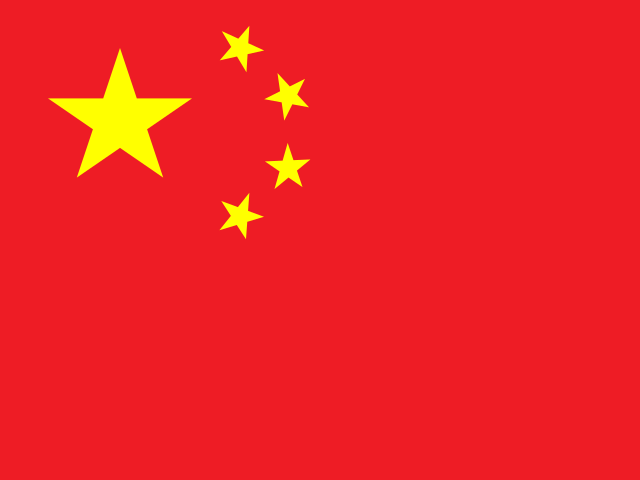
The Chinese flag consists of a red field with five golden five-pointed stars in the upper hoist corner. One large star is surrounded on its right by four smaller stars, each oriented toward the large star. The red field represents revolution, while the five stars symbolize the unity of the Chinese people under the leadership of the Communist Party of China. The proportion is 2:3. The design was adopted in September 1949, shortly before the People's Republic of China was formally proclaimed on 1 October 1949.
Colors and meaning
Red represents revolution and the revolutionary struggle of the Chinese people, while the five golden stars represent the unity of the Chinese people under the leadership of the Communist Party of China. The large star represents the Party and the four smaller stars represent the Chinese people.
Red field
Represents revolution and the revolutionary struggle of the Chinese people. Red was strongly associated with the communist movement and the establishment of the People's Republic of China.
Large golden star
Represents the leadership of the Communist Party of China. Its prominent position emphasizes the Party's leading role in the political system of the People's Republic of China.
Four smaller golden stars
Represent the Chinese people. Their arrangement around the large star symbolizes the unity of the Chinese people under the leadership of the Communist Party of China.
Golden color
The stars are golden-yellow, providing a strong contrast with the red field and giving the flag its distinctive appearance. The design uses red and yellow, colors with a long history of importance in Chinese culture and political symbolism.
History and adoption
The modern Chinese flag was created during the establishment of the People's Republic of China in 1949. Following the Chinese Communist Revolution and the victory of the Chinese Communist Party in the Chinese Civil War, the new government organized a public competition for a national flag. More than 3,000 designs were submitted. The winning design was created by Zeng Liansong, an accountant and political participant from Zhejiang. His design featured a large yellow star with four smaller stars on a red field. The flag was approved by the Chinese People's Political Consultative Conference in September 1949 and was first raised in Beijing on 1 October 1949, when the People's Republic of China was proclaimed. The basic design has remained unchanged since then.
Key facts
- Adopted
- 27 September 1949
- Proportion
- 2:3
- Designer
- Zeng Liansong
- Capital
- Beijing
- Country code
- CN
- Similar flags
- Vietnam, North Korea
Historical and related flags
China has used many different flags throughout its imperial, republican and modern history.
- Qing dynasty (1644–1912): The Qing dynasty adopted a yellow triangular dragon flag in the late 19th century as a national flag.
- Republic of China (1912–1928): The early republic used the Five-Colored Flag, with five horizontal stripes representing the country's major ethnic groups.
- Republic of China (1928–present): The Blue Sky, White Sun and a Wholly Red Earth flag became the national flag of the Republic of China.
- People's Republic of China (1949–present): Red field with one large golden star and four smaller golden stars.
- People's Liberation Army flag: Red field with the Chinese characters for the People's Liberation Army and a golden star.
- Hong Kong and Macao flags: Special administrative region flags introduced in 1997 and 1999 respectively, each incorporating five stars as a reference to China.
Frequently asked questions
What does the flag of China look like?
The flag of China has a red field with five golden five-pointed stars in the upper hoist corner. One large star represents the leadership of the Communist Party of China, while the four smaller stars represent the Chinese people and their unity around the Party. The proportion is 2:3.
When was the flag of China adopted?
The current flag of China was officially adopted on 27 September 1949.
What do the colors mean?
Red represents revolution and the revolutionary struggle of the Chinese people, while the five golden stars represent the unity of the Chinese people under the leadership of the Communist Party of China. The large star represents the Party and the four smaller stars represent the Chinese people.
Which flags look similar to the China flag?
Vietnam also uses a red field with a large golden star, but China has five stars arranged in the upper hoist corner. North Korea uses red, white and blue horizontal bands with a red star in a white disc. China's combination of five golden stars on a red field is distinctive.

 Mongolia
 Russia
 Kazakhstan
 North Korea
 Vietnam
 Laos