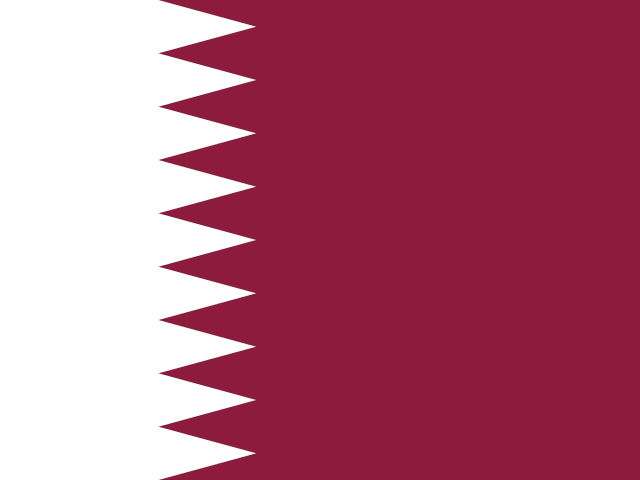
What the flag looks like
The Qatari flag consists of a maroon field with a white band on the hoist side, separated by a serrated edge with nine white points. The proportion is 11:28, making it one of the widest national flags in the world. It was adopted on 9 July 1971, shortly before Qatar gained independence from Britain on 3 September 1971.
Colors and meaning
Maroon represents the blood shed for Qatari independence and the country's historic connection to the dye industry of its past, and white represents peace and purity. The nine points of the serrated edge represent Qatar as the ninth member of the 'reconciled Emirates' of the Persian Gulf at the conclusion of the Qatari-British treaty of 1916.
Maroon
Represents the blood shed for Qatari independence and the country's historic dye industry. Qatar was once famous for its production of purple-red dye from shellfish, and the maroon color is a darker, deeper version of that historic dye.
White
Represents peace, purity and the Qatari people's commitment to a peaceful future.
Serrated edge
The zigzag line separating the white and maroon sections has nine white points. These nine points represent Qatar as the ninth member of the 'reconciled Emirates' of the Persian Gulf, following the Qatari-British treaty of 1916.
Proportions
Qatar's flag has a proportion of 11:28 — one of the widest national flags in the world. The unusual proportions were set in 1971 to distinguish the flag from the flag of Bahrain, which uses a similar design but with different proportions and colors.
History and adoption
Qatar was a British protectorate from 1916 until 1971, when it gained independence on 3 September 1971. The flag's design has its origins in the 19th century, when Qatar used a red flag with a white serrated band. The red color was changed to maroon in the early 20th century, following a suggestion that the original red faded too quickly in the sun, and after a visit by British officials noted the difference between Qatar's red and the red used by nearby Bahrain. The current design was standardized on 9 July 1971, shortly before independence, and has remained unchanged since.
Key facts
- Adopted
- 9 July 1971
- Proportion
- 11:28
- Designer
- Based on the historic Qatari red flag, refined in the 20th century
- Capital
- Doha
- Country code
- QA
- Similar flags
- Bahrain
Historical and related flags
Qatar has used several flags across its history.
- Early Qatari flags (19th century): Plain red flag.
- Al Thani dynasty (19th–20th century): Red flag with a white serrated band.
- British protectorate (1916–1971): Red and white flag, later changed to maroon and white.
- Current flag (1971–present): Maroon field with a white serrated band of nine points.
- Emir's standard: Uses the Qatari coat of arms with two crossed swords and a palm tree.
Frequently asked questions
What does the flag of Qatar look like?
The flag of Qatar is a maroon field with a white band on the hoist side, separated by a serrated (zigzag) line with nine white points. The proportion is 11:28 — one of the widest national flags in the world.
When was the flag of Qatar adopted?
The current flag of Qatar was officially adopted on 9 July 1971.
What do the colors mean?
Maroon represents the blood shed for Qatari independence and the country's historic connection to the dye industry of its past, and white represents peace and purity. The nine points of the serrated edge represent Qatar as the ninth member of the 'reconciled Emirates' of the Persian Gulf at the conclusion of the Qatari-British treaty of 1916.
Which flags look similar to the Qatar flag?
Bahrain uses a similar white and red design with a serrated edge but with only five points, a brighter red, and different proportions (3:5). Qatar's maroon color and 11:28 proportions distinguish it clearly from Bahrain's flag.

 Bahrain
 Saudi Arabia
 United Arab Emirates
 Oman
 Kuwait
 Iran