What the flag looks like
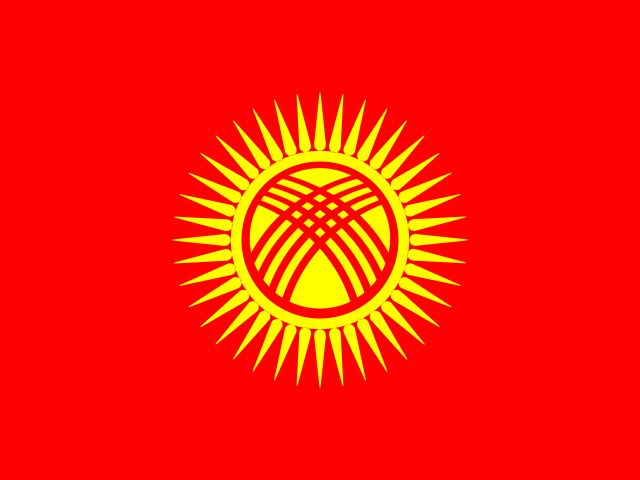
The Kyrgyz flag consists of a red field with a golden sun in the center, featuring 40 rays. Inside the sun is a red tunduk, the circular top of a traditional Kyrgyz yurt, with two sets of three curved lines radiating outward. The proportion is 3:5. It was adopted on 3 March 1992, following Kyrgyzstan's independence from the Soviet Union.
Colors and meaning
Red represents bravery, valor and the blood shed by Kyrgyz heroes for independence, and yellow represents the sun, warmth, wealth and the Kyrgyz people's aspiration for a bright future. The tunduk in the center represents the traditional Kyrgyz yurt and the unity of the Kyrgyz people.
Red
Represents bravery, valor and the blood shed by Kyrgyz heroes for their nation. Red is also the traditional color of Kyrgyz felt rugs and banners.
Yellow
Represents the sun, warmth, peace and wealth. The sun with its rays is a symbol of life, energy and the bright future of Kyrgyzstan.
Tunduk
The circular crown of the traditional Kyrgyz yurt, through which smoke escapes and light enters. It represents the traditional Kyrgyz home, the family and the unity of the Kyrgyz people. It is one of the most sacred symbols in Kyrgyz culture.
40 rays
Represent the 40 Kyrgyz tribes united by the legendary hero Manas, the central figure of the Kyrgyz epic poem.
Crossed lines
The two sets of three lines crossing the tunduk represent the wooden frame (uyuk) of the yurt, further emphasizing the traditional dwelling and its role as the center of Kyrgyz life.
History and adoption
The Kyrgyz flag was adopted on 3 March 1992, shortly after Kyrgyzstan declared independence from the Soviet Union on 31 August 1991. The design was created by a committee of artists and approved by the Supreme Council. In 2023, the flag was updated to straighten the wavy rays of the sun, which had caused confusion and complaints that the flag appeared to be a sunflower. The 40 rays and the tunduk symbol have remained consistent since 1992.
Key facts
- Adopted
- 3 March 1992 (updated 2023)
- Proportion
- 3:5
- Designer
- Committee of Kyrgyz artists (2023 redesign by the Supreme Council)
- Capital
- Bishkek
- Country code
- KG
- Similar flags
- None
Historical and related flags
Kyrgyzstan has used several flags across its khanate, Soviet and post-Soviet periods.
- Kokand Khanate (18th–19th century): Various banners used by Kyrgyz tribes.
- Kara-Kirghiz Autonomous Oblast (1924–1926): Soviet red flag with hammer and sickle.
- Kirghiz ASSR (1926–1936): Red flag with hammer and sickle and Cyrillic initials.
- Kirghiz SSR (1936–1952): Red flag with hammer and sickle and Cyrillic initials.
- Kirghiz SSR (1952–1991): Red flag with blue stripe and communist emblem.
- Current flag (1992–present): Red field with golden sun and tunduk. Rays straightened in 2023.
Frequently asked questions
What does the flag of Kyrgyzstan look like?
The flag of Kyrgyzstan has a red field with a golden sun in the center. Inside the sun is a red tunduk — the circular crown of a traditional Kyrgyz yurt — crossed by two sets of three lines. The proportion is 3:5.
When was the flag of Kyrgyzstan adopted?
The current flag of Kyrgyzstan was officially adopted on 3 March 1992 (updated 2023).
What do the colors mean?
Red represents bravery, valor and the blood shed by Kyrgyz heroes for independence, and yellow represents the sun, warmth, wealth and the Kyrgyz people's aspiration for a bright future. The tunduk in the center represents the traditional Kyrgyz yurt and the unity of the Kyrgyz people.
Which flags look similar to the Kyrgyzstan flag?
No other national flag closely resembles Kyrgyzstan's. The tunduk symbol is unique to Kyrgyz culture and does not appear on any other national flag.

 Kazakhstan
 Uzbekistan
 Tajikistan
 Turkmenistan
 Turkey
 Russia