What the flag looks like
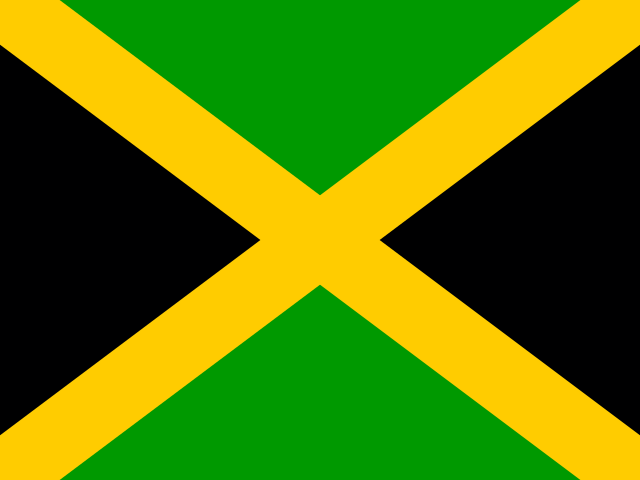
The Jamaican flag consists of a gold diagonal cross (saltire) that divides the field into four triangles. The top and bottom triangles are green, and the hoist and fly triangles are black. The proportion is 1:2. It was adopted on 6 August 1962, when Jamaica gained independence from Britain, making it the first Caribbean country to design a flag without colonial symbols.
Colors and meaning
Green represents the lush vegetation and agricultural wealth of Jamaica, gold represents the sunlight and the country's natural beauty, and black represents the strength and creativity of the Jamaican people. The design has been interpreted as a symbol of the sun shining over the land, with the strength of the people at its center.
Green
Represents the lush tropical vegetation of Jamaica, the country's agricultural wealth and hope for the future.
Gold
Represents the golden sunshine that bathes the island, the country's natural beauty and the warmth of the Jamaican people.
Black
Represents the strength, creativity and resilience of the Jamaican people, and their African heritage.
Design significance
Jamaica's flag was the first in the Caribbean to be designed without any colonial symbols. It replaced the British Blue Ensign used during the colonial period and represents a complete break with the colonial past.
History and adoption
Jamaica gained independence from Britain on 6 August 1962, and the new flag was adopted on the same day. A committee was formed to design the flag, and a design by a Jamaican artist was selected after modifications by the British College of Arms. The original design had horizontal stripes, but the final version used a diagonal cross (saltire). The flag's design has remained unchanged since independence. Jamaica is a constitutional monarchy and a member of the Commonwealth, but the flag makes no reference to the British crown.
Key facts
- Adopted
- 6 August 1962
- Proportion
- 1:2
- Designer
- A committee of the Jamaican House of Representatives (modified by the College of Arms)
- Capital
- Kingston
- Country code
- JM
- Similar flags
- None
Historical and related flags
Jamaica used several flags during its colonial period before independence.
- Spanish Jamaica (1494–1655): Spanish flag used during Spanish colonial rule.
- English Jamaica (1655–1707): English flag used during English rule.
- British Jamaica (1707–1962): British Blue Ensign with various colonial badges.
- Federation of the West Indies (1958–1962): Blue field with four white wavy stripes and a yellow sun.
- Current flag (1962–present): Gold saltire on green and black triangles.
- Jamaican Defence Force flag: Variant with the Jamaica Defence Force emblem.
Frequently asked questions
What does the flag of Jamaica look like?
The flag of Jamaica has a gold diagonal cross (saltire) dividing the field into four triangles — green at the top and bottom, black at the hoist and fly. The proportion is 1:2.
When was the flag of Jamaica adopted?
The current flag of Jamaica was officially adopted on 6 August 1962.
What do the colors mean?
Green represents the lush vegetation and agricultural wealth of Jamaica, gold represents the sunlight and the country's natural beauty, and black represents the strength and creativity of the Jamaican people. The design has been interpreted as a symbol of the sun shining over the land, with the strength of the people at its center.
Which flags look similar to the Jamaica flag?
No other national flag closely resembles Jamaica's. The combination of green, gold and black with a saltire design is unique among national flags.

 Cuba
 Haiti
 Dominican Republic
 Trinidad and Tobago
 Bahamas
 Barbados