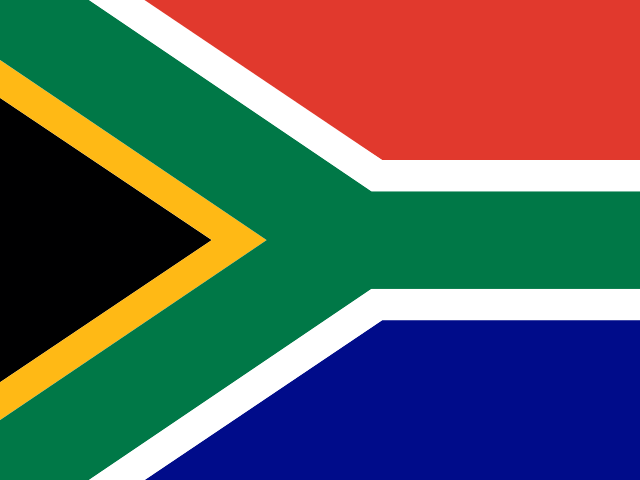
What the flag looks like
The South African flag is composed of a horizontal Y-shape (a heraldic pall) with a black isosceles triangle at the hoist, edged in yellow. The upper arm is red and the lower arm is blue, both bordered in white, with green forming the center of the Y. The design uses six colors — black, green, yellow, white, red and blue — making it one of the most colorful national flags in the world.
Colors and meaning
The design deliberately combines colors from both the previous national flag (orange, white and blue) and the African National Congress flag (black, green and yellow), symbolizing unity after apartheid. Black represents the people, green represents the land, yellow represents mineral wealth, white represents peace, red represents the blood shed for freedom, and blue represents the sky and oceans.
Black
Represents the Black African majority and, more broadly, the people of South Africa.
Green
Represents the land and its natural environment.
Yellow
Represents the country's mineral wealth, particularly gold.
White
Represents peace and the European population, included to signal reconciliation.
Red
Represents the blood shed during the struggle for freedom and independence.
Blue
Represents the sky and the two oceans that surround the country — the Atlantic and the Indian.
Y-shape
Represents the convergence of diverse peoples and traditions into one nation, and the road ahead.
History and adoption
The South African flag was designed by Frederick Brownell, then State Herald of South Africa, and adopted on 27 April 1994 — the day of the first democratic elections following the end of apartheid. It was intended to be an interim flag used for five years, but was retained because of its widespread popularity. The design combines colors from both the pre-1994 flag (orange, white, blue) and the ANC flag (black, green, yellow), deliberately avoiding any direct reference to either side of the apartheid conflict.
Key facts
- Adopted
- 27 April 1994
- Proportion
- 2:3
- Designer
- Frederick Brownell
- Capital
- Pretoria (executive), Cape Town (legislative), Bloemfontein (judicial)
- Country code
- ZA
- Similar flags
- None
Historical and related flags
Before 1994, South Africa used several different flags, each reflecting a different political era.
- Union of South Africa (1928–1994): Orange, white and blue horizontal bands with miniature Union Jack, Orange Free State and Transvaal flags in the center.
- Apartheid-era flag (1961–1994): Same as the Union flag after South Africa became a republic.
- 1910–1928: A red ensign variant used after the Union of South Africa was formed.
- Interim flag (1994–present): The current six-color design, originally intended as a five-year interim flag.
Frequently asked questions
What does the flag of South Africa look like?
The flag of South Africa has a horizontal Y-shaped design combining black, green, yellow, white, red and blue, with a black triangle at the hoist edged in yellow.
When was the flag of South Africa adopted?
The current flag of South Africa was officially adopted on 27 April 1994.
What do the colors mean?
The design deliberately combines colors from both the previous national flag (orange, white and blue) and the African National Congress flag (black, green and yellow), symbolizing unity after apartheid. Black represents the people, green represents the land, yellow represents mineral wealth, white represents peace, red represents the blood shed for freedom, and blue represents the sky and oceans.
Which flags look similar to the South Africa flag?
No other national flag closely resembles South Africa's. The six-color composition and Y-shape are unique in vexillology.

 Namibia
 Botswana
 Zimbabwe
 Mozambique
 Lesotho
 Eswatini