What the flag looks like
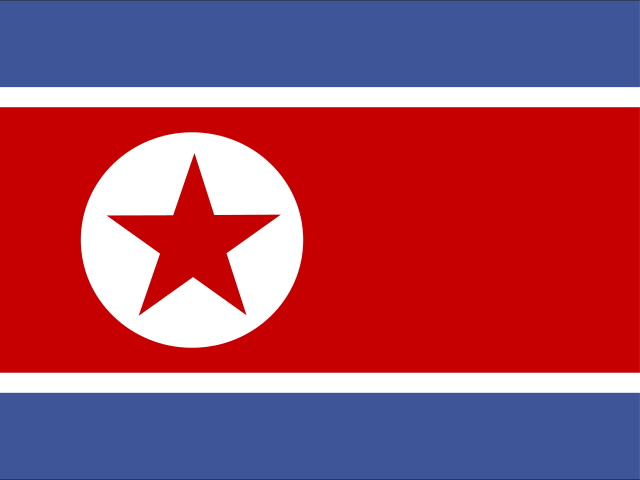
The North Korean flag consists of three horizontal bands: blue at the top and bottom, thin white stripes inside them, and a wide red band in the center. A white disc in the center of the red band bears a red five-pointed star. The proportion is 1:2. It was adopted on 10 July 1948, when the Democratic People's Republic of Korea was established, and has remained unchanged since.
Colors and meaning
The red band represents the revolutionary spirit and the blood shed by Korean patriots in the struggle against Japanese colonial rule, the white stripes represent purity and the traditional white clothing of the Korean people, and the blue bands represent sovereignty, peace and friendship. The red star represents communism and the revolutionary heritage of the country.
Red band
Represents the revolutionary traditions of the Korean people, the blood shed in the struggle against Japanese colonial rule (1910–1945), and the socialist revolution that established the Democratic People's Republic of Korea in 1948.
White stripes
Represent purity, peace, and the traditional white clothing worn by the Korean people for centuries. Korea has been known as the 'Land of the White-Clad People' since ancient times.
Blue bands
Represent sovereignty, peace and the desire for friendship with the peoples of the world. Blue also represents the Korean peninsula's surrounding seas.
White disc
Represents the Korean people's unity and their desire for harmony. The white disc also provides a contrasting background for the red star.
Red star
Represents communism and the revolutionary heritage of the country. The red star is a symbol shared by many socialist states, and its placement in the center of the flag emphasizes its importance in North Korean ideology.
History and adoption
Korea was under Japanese colonial rule from 1910 until 1945, when it was liberated at the end of World War II. The peninsula was divided into Soviet and American occupation zones, and in 1948 two separate governments were established — the Republic of Korea (South Korea) in the south and the Democratic People's Republic of Korea (North Korea) in the north. The North Korean flag was adopted on 10 July 1948, shortly before the DPRK was formally proclaimed on 9 September 1948. The design was created by the Soviet military administration and the Korean Workers' Party, and it was designed to be distinct from the South Korean flag, which was based on the traditional Taeguk symbol. The flag has remained unchanged since 1948, through the Korean War (1950–1953) and the decades that followed.
Key facts
- Adopted
- 10 July 1948
- Proportion
- 1:2
- Designer
- Soviet military administration and the Korean Workers' Party
- Capital
- Pyongyang
- Country code
- KP
- Similar flags
- Thailand, Costa Rica
Historical and related flags
North Korea has used the same flag since 1948, with several official variants for government use.
- Korean Empire (1897–1910): Various flags including the Taegukgi, used before Japanese annexation.
- Japanese Korea (1910–1945): Japanese flag used during colonial rule.
- Soviet occupation (1945–1948): Soviet flag used during occupation period.
- Current flag (1948–present): Blue, white and red bands with a white disc and red star.
- Korean People's Army flag: Uses the same design with military insignia.
- Workers' Party of Korea flag: Red flag with the party emblem of a hammer, sickle and brush.
Frequently asked questions
What does the flag of North Korea look like?
The flag of North Korea has three horizontal bands — blue (top and bottom), white (inner stripes) and a wide red center band. A white disc in the center of the red band bears a red five-pointed star. The proportion is 1:2.
When was the flag of North Korea adopted?
The current flag of North Korea was officially adopted on 10 July 1948.
What do the colors mean?
The red band represents the revolutionary spirit and the blood shed by Korean patriots in the struggle against Japanese colonial rule, the white stripes represent purity and the traditional white clothing of the Korean people, and the blue bands represent sovereignty, peace and friendship. The red star represents communism and the revolutionary heritage of the country.
Which flags look similar to the North Korea flag?
Thailand uses red-white-blue-white-red with the reverse color order. Costa Rica uses blue-white-red-white-blue with a different shade of blue. North Korea's wider red center band with a white disc and red star is unique.

 South Korea
 Japan
 China
 Vietnam
 Laos
 Cuba