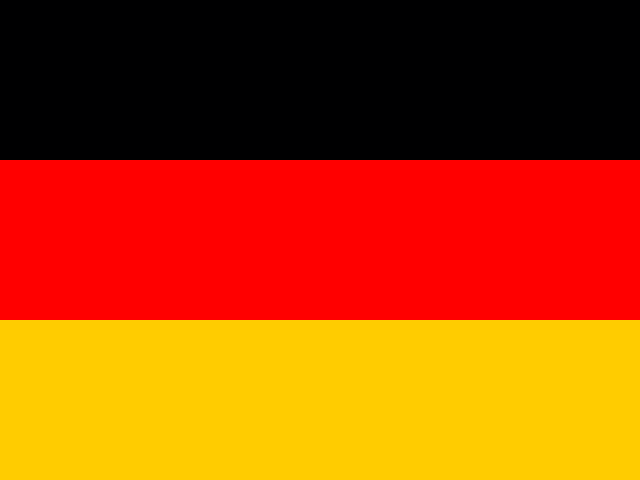
What the flag looks like
The German flag consists of three equal horizontal bands of black, red and gold. The flag proportion is 3:5. It was adopted in its current form on 23 May 1949 for West Germany and retained after reunification in 1990. The colors trace back to the uniforms of the Lützow Free Corps during the Napoleonic Wars and became the symbol of the 1848 German revolution.
Colors and meaning
The colors originated with the Lützow Free Corps during the Napoleonic Wars and became the symbol of the 1848 German revolution and the struggle for a unified, democratic Germany. Black represents determination and dignity, red represents bravery and hardiness, and gold represents generosity and the aspiration for freedom and unity.
Black
Represents determination, dignity and, historically, the dark uniforms of the Lützow Free Corps.
Red
Represents bravery, hardiness and the blood shed in the struggle for German unity.
Gold
Represents generosity, freedom and the golden buttons on the Free Corps' uniforms. Officially a golden yellow, not a metallic gold.
Origin (1813)
The Lützow Free Corps — a volunteer unit during the Napoleonic Wars — wore black uniforms with red trim and gold buttons. Members popularized the color combination on their return to civilian life.
1848 revolution
The Frankfurt Parliament adopted black-red-gold as the flag of a unified German state, cementing its association with liberal and democratic ideals.
History and adoption
The black-red-gold tricolor was first adopted by the Frankfurt Parliament in 1848 as the flag of a unified, democratic Germany. The Weimar Republic (1919–1933) used it as the national flag. The Nazi regime replaced it with a red flag bearing a swastika from 1933 to 1945. After World War II, both West Germany (1949) and East Germany (1949) adopted the black-red-gold tricolor. East Germany added a hammer-and-compass emblem in 1959, which West Germany considered a violation of the shared flag. On 3 October 1990, reunification restored the plain tricolor as the flag of a single Germany.
Key facts
- Adopted
- 23 May 1949 (re-adopted 3 October 1990)
- Proportion
- 3:5
- Designer
- Unknown — derived from the Lützow Free Corps uniforms
- Capital
- Berlin
- Country code
- DE
- Similar flags
- Belgium, Netherlands
Historical and related flags
Germany has had several national flags across different political eras. The black-red-gold tricolor is not the only design the country has used.
- German Empire (1871–1918): Black-white-red horizontal tricolor.
- Weimar Republic (1919–1933): Black-red-gold tricolor.
- Nazi Germany (1933–1945): Red flag with a black swastika on a white disc.
- East Germany (1949–1990): Black-red-gold with a hammer, compass and ring of rye.
- West Germany (1949–1990): Plain black-red-gold tricolor.
- Reunified Germany (1990–present): Plain black-red-gold tricolor.
Frequently asked questions
What does the flag of Germany look like?
The flag of Germany is a horizontal tricolor of black, red and gold (golden yellow) in three equal bands.
When was the flag of Germany adopted?
The current flag of Germany was officially adopted on 23 May 1949 (re-adopted 3 October 1990).
What do the colors mean?
The colors originated with the Lützow Free Corps during the Napoleonic Wars and became the symbol of the 1848 German revolution and the struggle for a unified, democratic Germany. Black represents determination and dignity, red represents bravery and hardiness, and gold represents generosity and the aspiration for freedom and unity.
Which flags look similar to the Germany flag?
Belgium uses vertical black-yellow-red bands, and the Netherlands uses horizontal red-white-blue. Germany is the only country with horizontal black-red-gold.

 Austria
 Belgium
 Netherlands
 Luxembourg
 France
 Poland