What the flag looks like
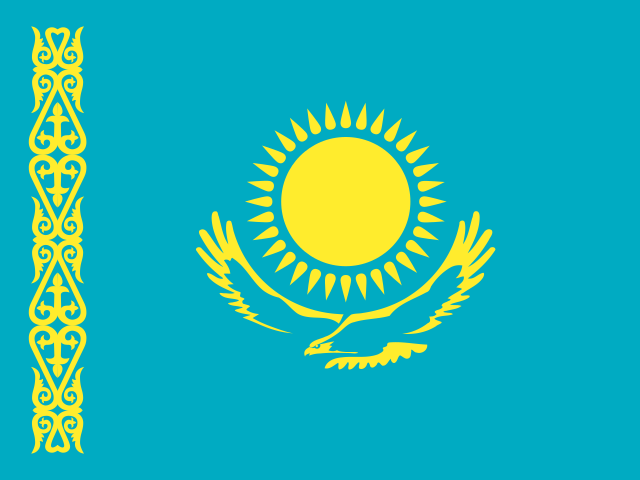
The Kazakh flag consists of a sky-blue field with a golden sun with 32 rays in the center, beneath which is a golden silhouette of a soaring steppe eagle. On the hoist side is a vertical band bearing the koshkar-muiz (ram's horns) ornamental pattern in gold. The proportion is 1:2. It was adopted on 4 June 1992, following Kazakhstan's independence from the Soviet Union in December 1991.
Colors and meaning
Sky blue represents the endless sky over the Kazakh steppe and the unity of the Turkic and Kazakh peoples, gold represents the wealth and prosperity of Kazakhstan, the sun represents life, energy and the source of all life, and the soaring eagle represents freedom, power and the Kazakh national spirit.
Sky blue
Represents the endless sky over the Kazakh steppe, and the unity of the Turkic peoples and the Kazakh nation. Sky blue is also a traditional Kazakh color of peace and tranquility.
Gold
Represents the wealth, prosperity and bright future of Kazakhstan. Gold is the color of the sun, the eagle and the ornamental pattern.
Sun with 32 rays
Represents life, energy, wealth and the source of all life. The 32 rays suggest the sun's generative power and Kazakhstan's abundance.
Steppe eagle
Represents freedom, power, courage and the Kazakh national spirit. The steppe eagle has long been a symbol of Kazakh nomadic culture and appears in traditional Kazakh art.
Koshkar-muiz ornament
The vertical ornamental stripe on the hoist side features the koshkar-muiz ('ram's horns') pattern, one of the most ancient Kazakh decorative motifs, representing the art and cultural heritage of the Kazakh people.
History and adoption
The Kazakh flag was designed by Shaken Niyazbekov and adopted on 4 June 1992, following Kazakhstan's independence from the Soviet Union on 16 December 1991. The design was chosen in a national competition, and the sky-blue color with sun, eagle and ornament was selected to reflect Kazakh cultural heritage. It was one of the first post-Soviet flags to incorporate traditional folk ornament. The flag has remained largely unchanged since, with only minor specification adjustments in 2007.
Key facts
- Adopted
- 4 June 1992
- Proportion
- 1:2
- Designer
- Shaken Niyazbekov
- Capital
- Astana
- Country code
- KZ
- Similar flags
- None
Historical and related flags
Kazakhstan has used several flags across its khanate, Soviet and post-Soviet periods.
- Kazakh Khanate (15th–19th century): Various tribal and khanate banners.
- Alash Autonomy (1917–1920): Flag of the short-lived Kazakh state.
- Kirghiz ASSR (1920–1936): Soviet red flag with hammer and sickle.
- Kazakh SSR (1936–1953): Red flag with hammer and sickle and Cyrillic initials.
- Kazakh SSR (1953–1991): Red flag with blue stripe and communist emblem.
- Current flag (1992–present): Sky-blue field with golden sun, eagle and ornament.
Frequently asked questions
What does the flag of Kazakhstan look like?
The flag of Kazakhstan has a sky-blue field with a golden sun with 32 rays above a soaring golden steppe eagle, and a vertical ornamental stripe (koshkar-muiz) on the hoist side. The proportion is 1:2.
When was the flag of Kazakhstan adopted?
The current flag of Kazakhstan was officially adopted on 4 June 1992.
What do the colors mean?
Sky blue represents the endless sky over the Kazakh steppe and the unity of the Turkic and Kazakh peoples, gold represents the wealth and prosperity of Kazakhstan, the sun represents life, energy and the source of all life, and the soaring eagle represents freedom, power and the Kazakh national spirit.
Which flags look similar to the Kazakhstan flag?
No other national flag closely resembles Kazakhstan's. The combination of sky-blue, sun, eagle and ornamental stripe is unique.

 Russia
 Kyrgyzstan
 Uzbekistan
 Turkmenistan
 Tajikistan
 Azerbaijan