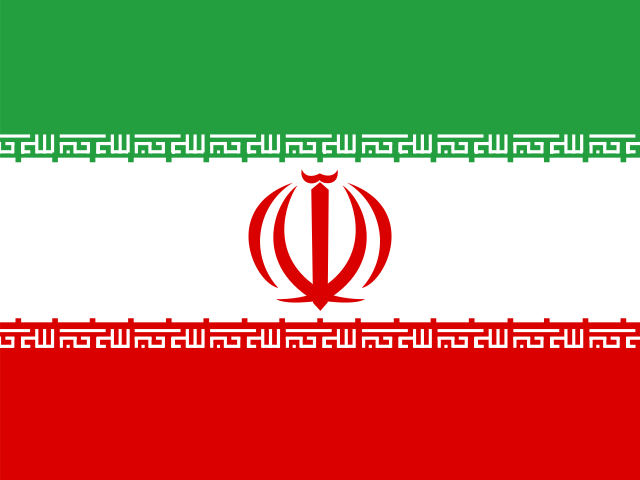
What the flag looks like
The Iranian flag consists of three horizontal bands of green (top), white (middle) and red (bottom), with the red national emblem in the center of the white band. The Takbir (الله أكبر, 'God is great') is written in white Kufic script 11 times along the edges of both the green and red bands. The proportion is 4:7. It was adopted on 29 July 1980, following the Iranian Revolution of 1979.
Colors and meaning
Green represents Islam and the country's Islamic heritage, white represents peace and honesty, and red represents the blood shed for Iranian independence and the martyrdom of those who died for the nation. The central emblem is a stylized representation of the word 'Allah' and the phrase 'There is no god but God'.
Green
Represents Islam, the dominant religion of Iran since the 7th century, and the country's Islamic heritage. Green is also a traditional color of Persian and Islamic banners, associated with paradise and the Prophet Muhammad.
White
Represents peace, honesty and the desire for a peaceful future. White is the middle band and provides a neutral background for the central emblem.
Red
Represents the blood shed by Iranian patriots for independence, and the martyrdom of those who died in the Iranian Revolution of 1979 and the Iran–Iraq War (1980–1988). Red is also a traditional Persian color of bravery and sacrifice.
Central emblem
The red emblem in the center of the flag is a stylized representation of the word 'Allah' (God), designed by Hamid Nadimi. It is composed of four crescents and a central vertical line, and can also be read as the phrase 'There is no god but God'. The emblem was approved by Ayatollah Khomeini after the 1979 revolution and replaced the earlier Lion and Sun emblem.
Takbir
The Takbir — 'God is great' — is written in white Kufic script 11 times along each of the edges of the green and red bands, making 22 repetitions in total. The number 22 is significant in Shia Islam, referring to the 22nd day of the month of Rajab, when the Prophet Muhammad received the first revelation.
History and adoption
Iran has used several flags across its imperial and Islamic periods. The flag of the Qajar dynasty (1789–1925) and later the Pahlavi dynasty (1925–1979) was a tricolor of green, white and red with the Lion and Sun emblem in the center. The Lion and Sun — a symbol of Persian royalty dating back to the 12th century — had been on Iranian flags since the 19th century. After the Iranian Revolution of 1979, the Islamic Republic was established and the flag was redesigned: the Lion and Sun was replaced with the current Islamic emblem and the Takbir was added along the edges of the green and red bands. The current design was adopted on 29 July 1980 and has remained unchanged since.
Key facts
- Adopted
- 29 July 1980
- Proportion
- 4:7
- Designer
- Hamid Nadimi (central emblem), based on a design approved by Ayatollah Khomeini
- Capital
- Tehran
- Country code
- IR
- Similar flags
- Hungary, Bulgaria
Historical and related flags
Iran has used several flags across its imperial and Islamic periods, with the tricolor base dating back to the early 20th century.
- Qajar dynasty (1789–1925): Green, white and red tricolor with the Lion and Sun.
- Pahlavi dynasty (1925–1979): Green, white and red tricolor with the Lion and Sun emblem and a crown.
- Interim government (1979–1980): Tricolor used without the Lion and Sun.
- Current flag (1980–present): Green, white and red with the Islamic emblem and Takbir script.
- Presidential standard: Uses the Iranian coat of arms on a blue field.
Frequently asked questions
What does the flag of Iran look like?
The flag of Iran has three horizontal bands of green (top), white (middle) and red (bottom), with a red national emblem in the center of the white band. The Takbir — 'God is great' — is written in white Arabic script 11 times along each edge of the colored bands. The proportion is 4:7.
When was the flag of Iran adopted?
The current flag of Iran was officially adopted on 29 July 1980.
What do the colors mean?
Green represents Islam and the country's Islamic heritage, white represents peace and honesty, and red represents the blood shed for Iranian independence and the martyrdom of those who died for the nation. The central emblem is a stylized representation of the word 'Allah' and the phrase 'There is no god but God'.
Which flags look similar to the Iran flag?
Hungary uses red-white-green — the reverse order of Iran's. Bulgaria uses white-green-red horizontal bands. Iran's green-white-red with the central Islamic emblem and Takbir script is unique.

 Iraq
 Turkey
 Afghanistan
 Pakistan
 Azerbaijan
 Armenia