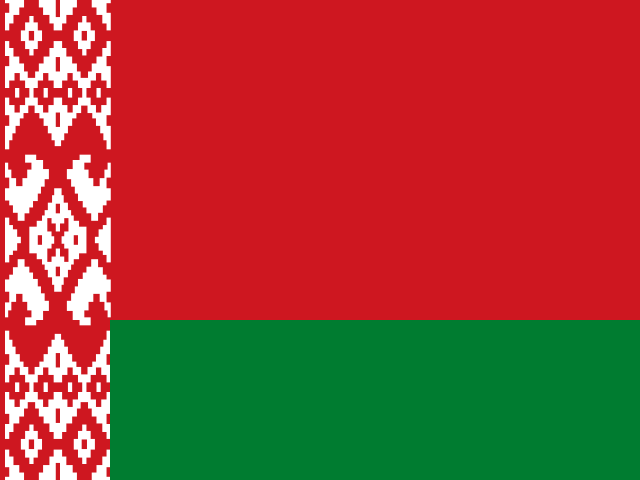
What the flag looks like
The Belarusian flag consists of a red horizontal band covering the upper two-thirds and a green horizontal band covering the lower third, with a vertical strip on the hoist side bearing a red-and-white ornamental pattern derived from traditional Belarusian embroidery. The proportion is 1:2. It was adopted on 7 June 1995, following a referendum that replaced the earlier white-red-white flag.
Colors and meaning
Red represents the blood shed for Belarusian independence and the courage of the Belarusian people, green represents the forests, fields and hope for the future, and white represents the snow, purity and traditional Belarusian culture. The ornamental pattern on the hoist represents the country's rich folk art traditions and its agricultural heritage.
Red
Represents the blood shed for Belarusian independence, the courage of the Belarusian people and the red banners used by the Belarusian resistance during World War II.
Green
Represents the forests, fields, meadows and hope for the future. Belarus is heavily forested, with forests covering about 40 percent of the country's territory.
White
Represents snow, purity and traditional Belarusian culture, and appears in the ornamental pattern and in the historic white-red-white flag used between 1918 and 1995.
Ornamental pattern
Derived from traditional Belarusian folk embroidery, the pattern on the hoist represents the country's folk art traditions, agricultural heritage and the harvest. The design is based on a 1917 pattern by Matrona Markevich.
History and adoption
Belarus declared independence in 1991 and adopted the white-red-white flag, which had been used by the short-lived Belarusian People's Republic in 1918. In a referendum on 14 May 1995, voters approved a new flag and coat of arms proposed by President Alexander Lukashenko, replacing the white-red-white design with the current red-and-green flag featuring the ornamental pattern. The new design was formally adopted on 7 June 1995. The white-red-white flag continues to be used by opposition groups and is widely recognized internationally as a symbol of democratic Belarus.
Key facts
- Adopted
- 7 June 1995
- Proportion
- 1:2
- Designer
- Mikhail Husyev (ornamental pattern based on Matrona Markevich's design)
- Capital
- Minsk
- Country code
- BY
- Similar flags
- None
Historical and related flags
Belarus has used several national flags across its Soviet, independence and post-independence periods.
- Belarusian People's Republic (1918): White-red-white flag used briefly.
- Byelorussian SSR (1919–1951): Red flag with hammer and sickle and Cyrillic initials.
- Byelorussian SSR (1951–1991): Red flag with green stripe and ornamental pattern.
- Republic of Belarus (1991–1995): White-red-white flag restored.
- Current flag (1995–present): Red-green flag with ornamental pattern.
- Opposition flag (1995–present): White-red-white continues in use by opposition groups.
Frequently asked questions
What does the flag of Belarus look like?
The flag of Belarus has a red upper band (two-thirds of the width) and a green lower band (one-third), with a vertical red-and-white ornamental pattern on the hoist side. The proportion is 1:2.
When was the flag of Belarus adopted?
The current flag of Belarus was officially adopted on 7 June 1995.
What do the colors mean?
Red represents the blood shed for Belarusian independence and the courage of the Belarusian people, green represents the forests, fields and hope for the future, and white represents the snow, purity and traditional Belarusian culture. The ornamental pattern on the hoist represents the country's rich folk art traditions and its agricultural heritage.
Which flags look similar to the Belarus flag?
No other national flag closely resembles Belarus's. The combination of red and green bands with an ornamental hoist pattern is unique.

 Russia
 Ukraine
 Poland
 Lithuania
 Latvia
 Kazakhstan