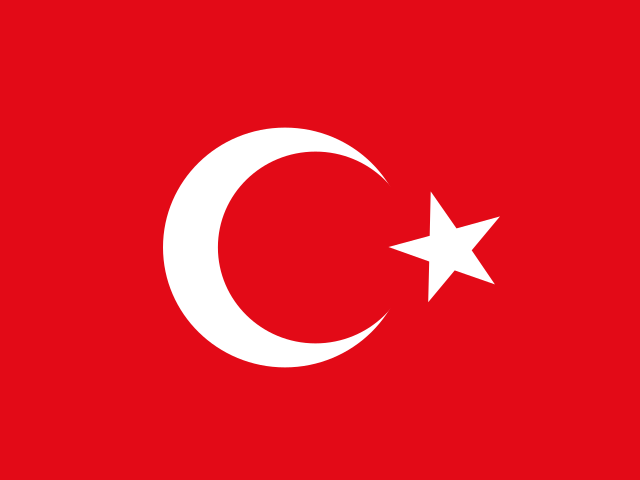
What the flag looks like
The Turkish flag consists of a red field with a white crescent moon and a white five-pointed star. The star is positioned inside the opening of the crescent, and the crescent faces the fly side of the flag. The proportion is 2:3. The design was formally standardized by the Turkish Flag Law of 29 May 1936.
Colors and meaning
Red represents the blood shed by Turkish soldiers in defense of the nation and the country's history of struggle, and white represents purity, peace and the crescent and star. The crescent and star are ancient symbols of Islam and of Turkish identity, used by Turkic peoples for centuries before the Ottoman Empire.
Red
Represents the blood of martyrs and the courage of the Turkish people. Red has been the Ottoman and Turkish national color since the 14th century.
White
Represents purity, peace and the light of the crescent and star. Also associated with the white banners of early Turkish Islamic states.
Crescent
An ancient symbol of Islam and of the Turkic peoples. Used by the Seljuk and Ottoman empires long before the modern republic.
Star
A five-pointed white star inside the crescent, representing the Turkish nation and, in some interpretations, the morning star referenced in the Turkish national anthem.
History and adoption
The red flag with a crescent and star has been used by Turkish states since the Ottoman Empire. The Ottomans adopted a red flag with a white crescent and star in the late 18th century, and the design evolved over the 19th century. After the founding of the Turkish Republic in 1923, the flag was retained with minor adjustments. The current proportions and design were formalized by the Turkish Flag Law (Türk Bayrağı Kanunu) on 29 May 1936, which remains in force.
Key facts
- Adopted
- 29 May 1936
- Proportion
- 2:3
- Designer
- Traditional Ottoman design formalized by law
- Capital
- Ankara
- Country code
- TR
- Similar flags
- Tunisia, Pakistan, Algeria
Historical and related flags
The crescent and star have appeared on Turkish flags for centuries, with different arrangements across Ottoman and modern periods.
- Ottoman Empire (1793–1844): Red flag with a white crescent and an eight-pointed star.
- Ottoman Empire (1844–1922): Red flag with a white crescent and a five-pointed star — the basis of the modern design.
- Turkish War of Independence (1919–1923): Same flag used by the nationalist movement.
- Republic of Turkey (1923–1936): Ottoman design used without formal standardization.
- Current flag (1936–present): Standardized by the Turkish Flag Law.
Frequently asked questions
What does the flag of Turkey look like?
The flag of Turkey is a red field with a white crescent moon and a white five-pointed star in the center-left.
When was the flag of Turkey adopted?
The current flag of Turkey was officially adopted on 29 May 1936.
What do the colors mean?
Red represents the blood shed by Turkish soldiers in defense of the nation and the country's history of struggle, and white represents purity, peace and the crescent and star. The crescent and star are ancient symbols of Islam and of Turkish identity, used by Turkic peoples for centuries before the Ottoman Empire.
Which flags look similar to the Turkey flag?
Tunisia uses a red field with a white circle containing a red crescent and star. Pakistan uses a green field with a white crescent and star. Algeria uses a green and white field with a red crescent and star. Turkey's star position inside the crescent is unique.

 Tunisia
 Pakistan
 Algeria
 Azerbaijan
 Malaysia
 Turkmenistan