What the flag looks like
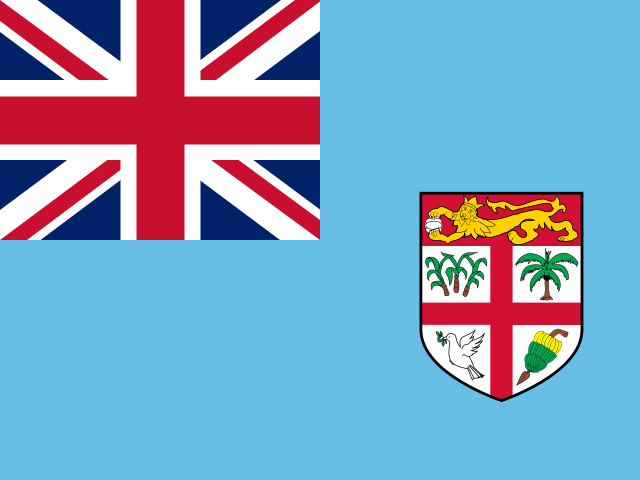
The Fijian flag consists of a light blue field with the Union Jack in the upper hoist corner and the national coat of arms displayed on a shield in the fly-side half. The shield features a British lion holding a cocoa pod above a cross with traditional Fijian agricultural symbols, including sugar cane, coconut palm and bananas. The light blue field represents the Pacific Ocean surrounding Fiji. The flag was adopted on 10 October 1970, when Fiji became independent from the United Kingdom, and has remained in use since.
Colors and meaning
Light blue represents the Pacific Ocean surrounding Fiji. The Union Jack reflects Fiji's historical relationship with Britain, while the coat of arms represents the country's agricultural heritage, traditional culture, peace and national identity.
Light blue field
Represents the Pacific Ocean surrounding the Fijian islands and the country's maritime identity.
Union Jack
Represents Fiji's historical relationship with the United Kingdom and its period as a British colony. Fiji retained the Union Jack after independence as part of its national flag.
Coat of arms
The shield contains a British lion holding a cocoa pod, a red cross and traditional agricultural symbols including sugar cane, coconut palms and bananas. These elements reflect Fiji's history, agriculture and cultural heritage.
Sugar cane, coconut and bananas
Represent important traditional agricultural products and the economic and cultural importance of farming in Fiji.
Red and white
The red and white elements appear primarily within the Union Jack and coat of arms and reflect the heraldic colors of Fiji's historical national symbolism.
History and adoption
Fiji was a British colony from 1874 until independence in 1970. Several colonial flags were used during the British period, including designs incorporating the Union Jack and the colonial coat of arms. As independence approached, Fiji held a competition to develop a national flag. The final design retained the Union Jack but replaced the dark colonial blue field with a lighter blue representing the Pacific Ocean and incorporated the Fijian coat of arms. The flag was officially adopted on 10 October 1970, the day Fiji became independent. Although there have been proposals to replace the Union Jack with a more distinctly indigenous design, the current flag remains the national flag.
Key facts
- Adopted
- 10 October 1970
- Proportion
- 1:2
- Designer
- Based on the design of the Fijian coat of arms and British Blue Ensign traditions
- Capital
- Suva
- Country code
- FJ
- Similar flags
- Tuvalu, New Zealand
Historical and related flags
Fiji's flags have changed substantially from traditional chiefly banners to British colonial designs and the current national flag.
- Traditional Fijian flags: Various banners and symbols were used by Fijian chiefs and kingdoms before colonial rule.
- Kingdom of Fiji (1871–1874): Used flags associated with the short-lived independent Kingdom of Fiji.
- British colonial Fiji (1874–1970): Used British Blue Ensign-based designs incorporating the colonial badge.
- Current flag (1970–present): Light blue field with the Union Jack and the Fijian coat of arms.
- Fijian naval and government flags: Separate official ensigns and standards are used by government institutions and the military.
Frequently asked questions
What does the flag of Fiji look like?
The flag of Fiji has a light blue field with the Union Jack in the upper hoist corner and the national coat of arms on a shield at the fly side. The light blue represents the Pacific Ocean, while the shield contains symbols of Fiji's agricultural heritage, peace and traditional identity. The proportion is 1:2.
When was the flag of Fiji adopted?
The current flag of Fiji was officially adopted on 10 October 1970.
What do the colors mean?
Light blue represents the Pacific Ocean surrounding Fiji. The Union Jack reflects Fiji's historical relationship with Britain, while the coat of arms represents the country's agricultural heritage, traditional culture, peace and national identity.
Which flags look similar to the Fiji flag?
Fiji's flag shares the Union Jack with several former British territories, including Tuvalu and New Zealand. Fiji is distinguished by its light blue field and the Fijian coat of arms displayed on the fly side.

 Tuvalu
 New Zealand
 Australia
 United Kingdom
 Solomon Islands
 Vanuatu