What the flag looks like
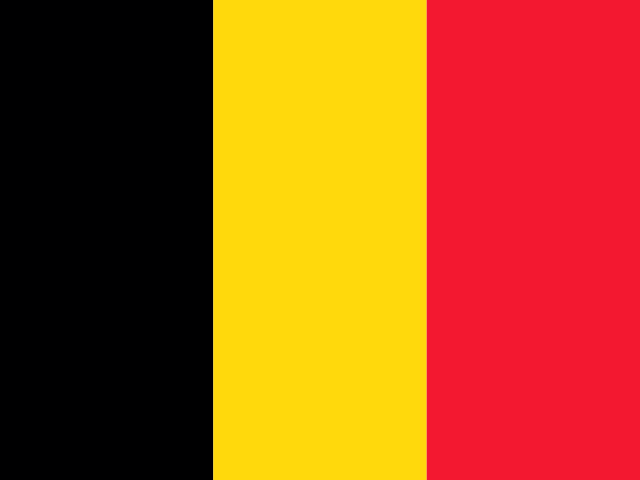
The Belgian flag consists of three equal vertical bands of black (hoist), yellow (center) and red (fly). The proportion is 13:15, unusually close to square compared to most national flags. It was adopted on 23 January 1831, shortly after Belgium declared independence from the Netherlands in 1830.
Colors and meaning
The colors come from the coat of arms of the Duchy of Brabant, which features a golden lion with red claws and tongue on a black field. Black represents the field of the arms, yellow the lion and red the claws and tongue. They are also the colors used in the Brabant Revolution of 1789–1790, which briefly established the United Belgian States.
Black
Represents the field of the coat of arms of the Duchy of Brabant, the historical region that includes Brussels and Antwerp.
Yellow
Represents the golden lion of Brabant, the heraldic symbol of the duchy.
Red
Represents the red claws and tongue of the Brabant lion. Red also features in the coats of arms of other Belgian provinces including Hainaut and Limburg.
Origin
The colors were used during the Brabant Revolution in 1789, when the southern Netherlands briefly declared independence from Austria as the United Belgian States. They were reused in 1830 during the Belgian Revolution against the Netherlands.
History and adoption
The Belgian flag was adopted on 23 January 1831, four months after Belgium declared independence from the United Kingdom of the Netherlands in October 1830. The colors were drawn from the coat of arms of Brabant and from the flag used by the Brabant Revolution of 1789. The original design had horizontal bands, but the vertical arrangement was chosen to distinguish it from the Dutch flag. The proportions have changed slightly over time, and the current version uses a 13:15 ratio, which is closer to square than most national flags.
Key facts
- Adopted
- 23 January 1831
- Proportion
- 13:15
- Designer
- Unknown — based on the Brabant coat of arms
- Capital
- Brussels
- Country code
- BE
- Similar flags
- Germany, Netherlands
Historical and related flags
Belgium has used several flags since its independence, and regional flags exist for Flanders, Wallonia and Brussels.
- Brabant Revolution (1789–1790): Black-yellow-red horizontal flag of the United Belgian States.
- Belgian Revolution (1830): Horizontal tricolor used by revolutionaries.
- Current flag (1831–present): Vertical black-yellow-red tricolor.
- State flag: Uses a 2:3 proportion with the Belgian coat of arms.
- Flanders: Black lion on a yellow field.
- Wallonia: Yellow rooster on a red field.
- Brussels: Yellow iris on a blue and white field.
Frequently asked questions
What does the flag of Belgium look like?
The flag of Belgium has three equal vertical bands of black (hoist), yellow (center) and red (fly). The proportion is 13:15.
When was the flag of Belgium adopted?
The current flag of Belgium was officially adopted on 23 January 1831.
What do the colors mean?
The colors come from the coat of arms of the Duchy of Brabant, which features a golden lion with red claws and tongue on a black field. Black represents the field of the arms, yellow the lion and red the claws and tongue. They are also the colors used in the Brabant Revolution of 1789–1790, which briefly established the United Belgian States.
Which flags look similar to the Belgium flag?
Germany uses horizontal black-red-gold bands. The Netherlands uses horizontal red-white-blue. Belgium's vertical black-yellow-red is unique, though it shares colors with Germany in a different arrangement.

 Germany
 Netherlands
 Luxembourg
 France
 Spain
 Austria