What the flag looks like
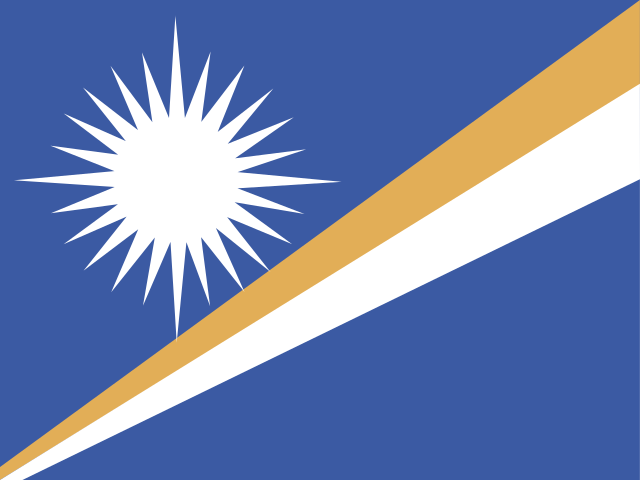
The Marshallese flag consists of a blue field with two diagonal rays extending from the lower hoist corner to the upper fly corner. The upper ray is orange and the lower ray is white, both widening as they extend toward the fly. A white 24-pointed star sits in the upper hoist corner, above the orange ray. The proportion is 10:19. It was adopted on 1 May 1979, when the Marshall Islands became a self-governing republic, and was retained when the country gained full independence in 1986.
Colors and meaning
Blue represents the Pacific Ocean that surrounds the Marshall Islands, orange represents courage and the sunrise, and white represents peace and the traditional Marshallese navigation stick charts. The 24-pointed star represents the 24 municipalities (local government areas) of the Marshall Islands.
Blue field
Represents the Pacific Ocean that surrounds the Marshall Islands — an archipelago of 29 coral atolls and five isolated islands scattered across about 1.9 million square kilometers of ocean, but with a total land area of only 181 square kilometers.
Orange ray
Represents courage and the sunrise — the Marshall Islands are located just north of the equator, and the sunrise over the Pacific is a daily feature of life on the atolls. Orange also represents the traditional Marshallese woven mats and other cultural items.
White ray
Represents peace, and the white color reflects the traditional Marshallese navigation stick charts — intricate maps made from sticks and shells that Marshallese navigators used to navigate across the Pacific. The diagonal rays themselves represent the stick charts, with the orange and white colors representing the two types of waves that Marshallese navigators used to find their way across the ocean.
24-pointed star
Represents the 24 municipalities (local government areas) of the Marshall Islands — one point for each of the country's electoral districts. The star is white, symbolizing peace and harmony among the country's communities.
History and adoption
The Marshall Islands were a German colony from 1885 to 1914, then a Japanese mandate from 1919 to 1944, and finally part of the United States-administered Trust Territory of the Pacific Islands from 1947 to 1979. During the Cold War, the United States conducted nuclear tests in the Marshall Islands, including the famous Castle Bravo test at Bikini Atoll in 1954. In 1979, the Marshall Islands became a self-governing republic, and the current flag was adopted on 1 May 1979. The country gained full independence in 1986 under a Compact of Free Association with the United States. The flag has remained unchanged since.
Key facts
- Adopted
- 1 May 1979
- Proportion
- 10:19
- Designer
- Emlain Kabua
- Capital
- Majuro
- Country code
- MH
- Similar flags
- None
Historical and related flags
The Marshall Islands used several flags during its German, Japanese and American periods before self-government.
- German New Guinea (1885–1914): German colonial flags.
- Japanese South Seas Mandate (1919–1944): Japanese flag used.
- US Trust Territory (1947–1979): United States flag and Trust Territory flag used.
- Current flag (1979–present): Blue field with orange and white rays and a 24-pointed star.
- Presidential standard: Uses the Marshallese coat of arms with a bird and a fish.
Frequently asked questions
What does the flag of Marshall Islands look like?
The flag of the Marshall Islands is a blue field with two diagonal rays extending from the lower hoist corner to the upper fly corner — orange on top and white below — and a white 24-pointed star in the upper hoist corner. The proportion is 10:19.
When was the flag of Marshall Islands adopted?
The current flag of Marshall Islands was officially adopted on 1 May 1979.
What do the colors mean?
Blue represents the Pacific Ocean that surrounds the Marshall Islands, orange represents courage and the sunrise, and white represents peace and the traditional Marshallese navigation stick charts. The 24-pointed star represents the 24 municipalities (local government areas) of the Marshall Islands.
Which flags look similar to the Marshall Islands flag?
No other national flag closely resembles the Marshall Islands'. The combination of a blue field with orange and white diagonal rays and a 24-pointed star is unique.

 Micronesia
 Palau
 Nauru
 Kiribati
 Tuvalu
 Samoa