What the flag looks like
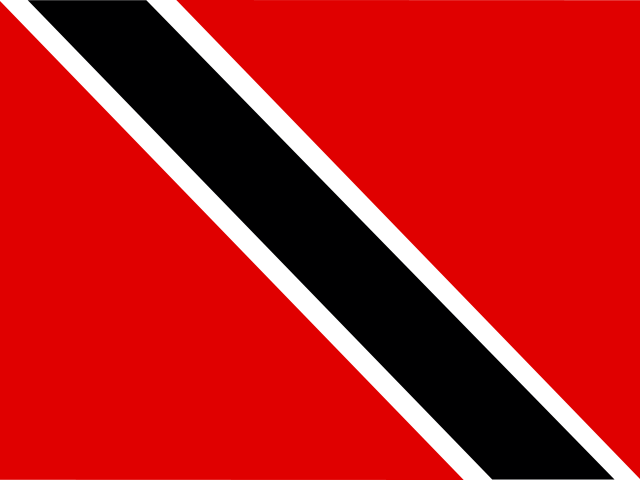
The flag of Trinidad and Tobago consists of a red field with a black diagonal band running from the upper hoist corner to the lower fly corner, bordered on both sides by thin white stripes. The proportion is 3:5. It was adopted on 31 August 1962, when Trinidad and Tobago gained independence from Britain.
Colors and meaning
Red represents the warmth and energy of the sun and the vitality of the people of Trinidad and Tobago, black represents the strength and unity of the people and the country's mineral wealth, and white represents the sea that surrounds the two islands, the purity of national aspirations and the equality of all people under the sun.
Red field
Represents the warmth and energy of the tropical sun, and the vitality, friendliness and courage of the people of Trinidad and Tobago. Red is also a color of celebration and joy in Caribbean culture.
Black diagonal band
Represents the strength and unity of the people, and the country's mineral wealth — Trinidad and Tobago has significant oil and natural gas reserves, and the country's economy has been based on petroleum since the early 20th century. Black is also a color of determination and resilience.
White stripes
Represent the Caribbean Sea and the Atlantic Ocean that surround the two islands, and the purity of the nation's aspirations. The white stripes also represent the equality of all people under the sun, a founding principle of the nation.
Design origin
The flag was designed by Carlisle Chang, a Trinidadian artist, in a competition held in 1962 in preparation for independence. The diagonal band is meant to represent the two islands of Trinidad and Tobago connecting and moving forward together as one nation. The design was adopted on 31 August 1962, the day of independence.
History and adoption
Trinidad and Tobago was a British colony from 1802 until 1962, when it gained independence on 31 August 1962. The flag was designed by Carlisle Chang, a Trinidadian artist, in a national competition held in preparation for independence. It was adopted on independence day and has remained unchanged since, including when Trinidad and Tobago became a republic within the Commonwealth in 1976. The design reflects the country's dual-island identity and its aspiration for unity and progress.
Key facts
- Adopted
- 31 August 1962
- Proportion
- 3:5
- Designer
- Carlisle Chang
- Capital
- Port of Spain
- Country code
- TT
- Similar flags
- None
Historical and related flags
Trinidad and Tobago used several flags during its British colonial period before independence.
- British Trinidad (1802–1889): British Blue Ensign with a colonial badge for Trinidad.
- British Tobago (1763–1889): British Blue Ensign with a colonial badge for Tobago.
- British Trinidad and Tobago (1889–1962): Blue Ensign with a combined colonial badge.
- West Indies Federation (1958–1962): Blue field with four white wavy stripes and a yellow sun.
- Current flag (1962–present): Red field with black diagonal band bordered in white.
- Presidential standard: Uses the Trinidadian coat of arms with two hummingbirds and a ship.
Frequently asked questions
What does the flag of Trinidad and Tobago look like?
The flag of Trinidad and Tobago is a red field with a black diagonal band running from the upper hoist corner to the lower fly corner, bordered on both sides by thin white stripes. The proportion is 3:5.
When was the flag of Trinidad and Tobago adopted?
The current flag of Trinidad and Tobago was officially adopted on 31 August 1962.
What do the colors mean?
Red represents the warmth and energy of the sun and the vitality of the people of Trinidad and Tobago, black represents the strength and unity of the people and the country's mineral wealth, and white represents the sea that surrounds the two islands, the purity of national aspirations and the equality of all people under the sun.
Which flags look similar to the Trinidad and Tobago flag?
No other national flag closely resembles Trinidad and Tobago's. The combination of a red field with a black diagonal band bordered in white is unique, though the diagonal band design is shared with other flags such as the Republic of the Congo and Vanuatu.

 Jamaica
 Barbados
 Guyana
 Bahamas
 Grenada
 Venezuela