What the flag looks like
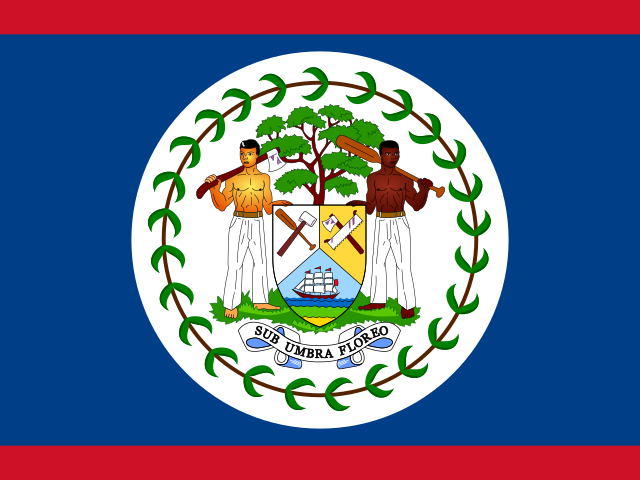
The Belizean flag consists of a blue field with a red horizontal stripe running along both the top and bottom edges. In the center, on a white disc, is the Belizean coat of arms — two woodcutters flanking a shield bearing a ship, tools and a mahogany tree, with the motto 'Sub Umbra Floreo' below. The proportion is 2:3. It was adopted on 21 September 1981, when Belize gained independence from Britain.
Colors and meaning
Blue represents the Caribbean Sea and the People's United Party, which led Belize to independence, red represents the blood shed by Belizean patriots and the opposition United Democratic Party, and white represents peace and the unity of the Belizean people. The coat of arms represents the country's colonial and logging heritage.
Blue
Represents the Caribbean Sea that borders Belize to the east, and the color of the People's United Party, which led the country to independence in 1981.
Red
Represents the blood shed by Belizean patriots in the struggle for independence, and the color of the opposition United Democratic Party. The two parties' colors were combined on the flag as a symbol of national unity.
White
Represents peace, purity and the unity of the Belizean people. It forms the disc on which the coat of arms is placed.
Coat of arms
Features two woodcutters — one of African descent and one of European descent — flanking a shield with a ship, a mahogany tree and tools. This represents the country's colonial logging history and the multiethnic heritage of Belize. The motto 'Sub Umbra Floreo' means 'I flourish in the shade'.
History and adoption
Belize was a British colony known as British Honduras until 1973, when it was renamed Belize. The colony used a British Blue Ensign with a colonial badge. When Belize gained independence on 21 September 1981, the current flag was adopted, based on the flag of the People's United Party but with the addition of the red stripes to represent the opposition United Democratic Party and to symbolize national unity. The coat of arms was adopted in 1981 and modified slightly in 1982. The flag has remained unchanged since.
Key facts
- Adopted
- 21 September 1981
- Proportion
- 2:3
- Designer
- Everal Waight (current design)
- Capital
- Belmopan
- Country code
- BZ
- Similar flags
- None
Historical and related flags
Belize used several flags during its colonial period before independence.
- British Honduras (1870–1962): British Blue Ensign with a colonial badge.
- British Honduras (1962–1973): Blue Ensign with an updated badge.
- British Honduras (1973–1981): Blue Ensign with the coat of arms, used as the colony prepared for independence.
- Opposition flag (1973–1981): Blue flag with coat of arms on a white disc, used by the People's United Party.
- Current flag (1981–present): Blue field with red stripes and coat of arms.
Frequently asked questions
What does the flag of Belize look like?
The flag of Belize has a blue field with a red stripe along the top and bottom edges, and a white disc in the center bearing the Belizean coat of arms. The proportion is 2:3.
When was the flag of Belize adopted?
The current flag of Belize was officially adopted on 21 September 1981.
What do the colors mean?
Blue represents the Caribbean Sea and the People's United Party, which led Belize to independence, red represents the blood shed by Belizean patriots and the opposition United Democratic Party, and white represents peace and the unity of the Belizean people. The coat of arms represents the country's colonial and logging heritage.
Which flags look similar to the Belize flag?
No other national flag closely resembles Belize's. The combination of a blue field with red stripes and a large central coat of arms on a white disc is unique among national flags.

 Guatemala
 Mexico
 Honduras
 Jamaica
 United Kingdom
 Costa Rica