What the flag looks like
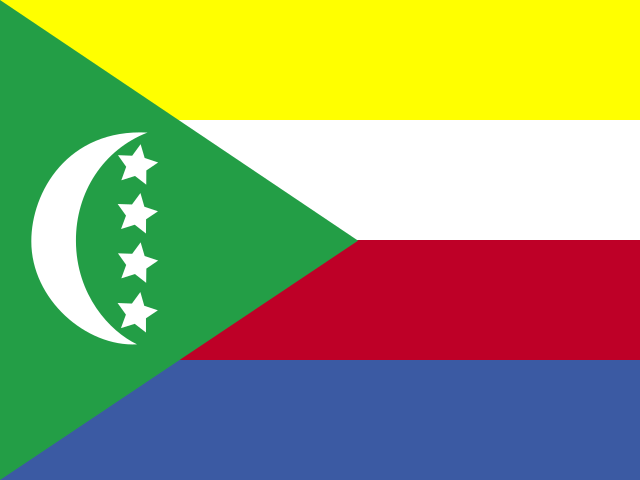
The Comorian flag consists of four horizontal bands of yellow (top), white, red and blue (bottom), with a green isosceles triangle at the hoist containing a white crescent moon and four white five-pointed stars. The proportion is 3:5. It was adopted on 23 December 2001, following the 2001 constitution that created the Union of the Comoros with its four autonomous islands.
Colors and meaning
The four horizontal bands represent the four main islands of the Comoros archipelago — yellow for Mohéli, white for Mayotte (which remains under French administration), red for Anjouan and blue for Grande Comore. The green triangle and crescent represent Islam, and the four stars represent the four islands.
Yellow band
Represents the island of Mohéli (Mwali), the smallest of the four main Comorian islands.
White band
Represents the island of Mayotte (Maoré), which voted to remain under French administration in 1974 and 1976, and is still claimed by the Comoros. Its inclusion on the flag reflects the Comorian government's continued claim to the island.
Red band
Represents the island of Anjouan (Ndzuwani), the second-largest island and the site of several political crises in the 1990s and 2000s.
Blue band
Represents the island of Grande Comore (Ngazidja), the largest and most populous island, home to the capital Moroni.
Green triangle
Represents Islam, the dominant religion of the Comoros, and peace. Green is the traditional color of Islam and appears on many Muslim national flags.
Crescent and four stars
The white crescent represents Islam. The four white stars represent the four main islands of the archipelago, matching the four colors of the horizontal bands.
History and adoption
The Comoros archipelago was a French colony from 1841 to 1975, when three of the four islands — Grande Comore, Anjouan and Mohéli — declared independence on 6 July 1975. Mayotte voted to remain French and continues to be administered by France. The Comoros has changed its flag several times since independence — a green flag with a crescent and stars was used from 1975 to 1978, a red and green flag with the Islamic crescent was used briefly, and a green flag with a white crescent and four stars was used from 1996 to 2001. The current flag was adopted on 23 December 2001, when the new constitution created the Union of the Comoros and gave each island its own color on the national flag.
Key facts
- Adopted
- 23 December 2001
- Proportion
- 3:5
- Designer
- Based on the 2001 constitution
- Capital
- Moroni
- Country code
- KM
- Similar flags
- None
Historical and related flags
Comoros has used several flags since independence, reflecting the country's political instability.
- French Comoros (1841–1975): French flag used during colonial rule.
- First independence flag (1975–1978): Green field with a red crescent and four stars.
- Second flag (1978–1992): Green field with a white crescent and four stars.
- Third flag (1992–1996): Similar design with a red crescent.
- Fourth flag (1996–2001): Green field with a white crescent and four stars, more formally standardized.
- Current flag (2001–present): Four horizontal bands with a green hoist triangle.
Frequently asked questions
What does the flag of Comoros look like?
The flag of Comoros has four horizontal bands of yellow, white, red and blue, with a green triangle at the hoist bearing a white crescent and four white five-pointed stars. The proportion is 3:5.
When was the flag of Comoros adopted?
The current flag of Comoros was officially adopted on 23 December 2001.
What do the colors mean?
The four horizontal bands represent the four main islands of the Comoros archipelago — yellow for Mohéli, white for Mayotte (which remains under French administration), red for Anjouan and blue for Grande Comore. The green triangle and crescent represent Islam, and the four stars represent the four islands.
Which flags look similar to the Comoros flag?
No other national flag closely resembles Comoros's. The combination of four horizontal bands in yellow, white, red and blue with a green hoist triangle is unique.

 Madagascar
 Mauritius
 Seychelles
 Tanzania
 Mozambique
 France