What the flag looks like
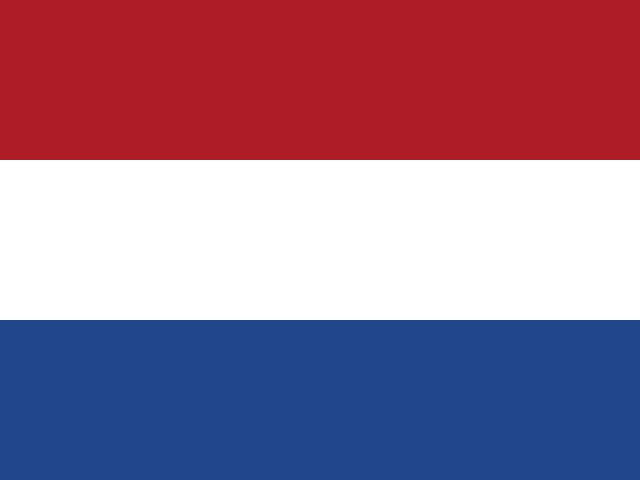
The Dutch flag consists of three equal horizontal bands of red (top), white (middle) and blue (bottom). The proportion is 2:3. It is the oldest tricolor still in national use, dating back to the Dutch Revolt in the 16th century. The current red-white-blue arrangement was formalized by royal decree on 19 February 1937.
Colors and meaning
The colors derive from the livery of William of Orange, leader of the Dutch Revolt. The original flag was orange-white-blue (the Prinsenvlag), but the orange was gradually replaced by red for better visibility at sea. Red represents courage and the people, white represents peace and honesty, and blue represents loyalty and the sea.
Red
Represents courage, bravery and the blood shed for independence. It replaced the orange of the original Prinsenvlag, which faded at sea.
White
Represents peace, honesty and the desire for freedom.
Blue
Represents loyalty, justice and the sea, a central part of Dutch identity.
Origin — Prinsenvlag
The original flag used orange, white and blue, after William of Orange. It was used during the Dutch Revolt (1568–1648) and is still associated with Dutch nationalists.
Red-white-blue
By the 17th century, the orange band had been widely replaced by red. The change became standard and was formalized in 1937.
History and adoption
The Dutch flag is the oldest tricolor in continuous use. Its origins trace to the Dutch Revolt against Spanish rule in the 16th century, when rebels used the Prinsenvlag — orange, white and blue — inspired by William of Orange. By the 1630s, the orange had been widely replaced by red, giving the modern red-white-blue tricolor. The design influenced many other flags, including Russia's, South Africa's and the flag of New York City. The current design was formally adopted by royal decree on 19 February 1937.
Key facts
- Adopted
- 19 February 1937
- Proportion
- 2:3
- Designer
- Traditional — derived from the Prinsenvlag
- Capital
- Amsterdam
- Country code
- NL
- Similar flags
- Luxembourg, France, Yugoslavia
Historical and related flags
The Dutch flag has evolved from a three-colored princely banner into the modern national flag.
- Prinsenvlag (1568–1664): Orange, white and blue, after William of Orange.
- States Flag (1664–1795): Red, white and blue, used by the Dutch Republic.
- Batavian Republic (1795–1806): Added a small emblem in the canton.
- Kingdom of Holland (1806–1810): Varied designs under French influence.
- Kingdom of the Netherlands (1815–present): Red-white-blue tricolor restored.
- Royal decree (1937–present): Formalized the exact shades.
Frequently asked questions
What does the flag of Netherlands look like?
The flag of the Netherlands has three equal horizontal bands of red, white and blue, with red at the top.
When was the flag of Netherlands adopted?
The current flag of Netherlands was officially adopted on 19 February 1937.
What do the colors mean?
The colors derive from the livery of William of Orange, leader of the Dutch Revolt. The original flag was orange-white-blue (the Prinsenvlag), but the orange was gradually replaced by red for better visibility at sea. Red represents courage and the people, white represents peace and honesty, and blue represents loyalty and the sea.
Which flags look similar to the Netherlands flag?
Luxembourg uses a horizontal red-white-blue tricolor with lighter blue and different proportions. France uses vertical bands. The Dutch flag's dark blue and red are distinct from Luxembourg's lighter shades.

 Belgium
 Luxembourg
 Germany
 France
 Russia
 South Africa