What the flag looks like
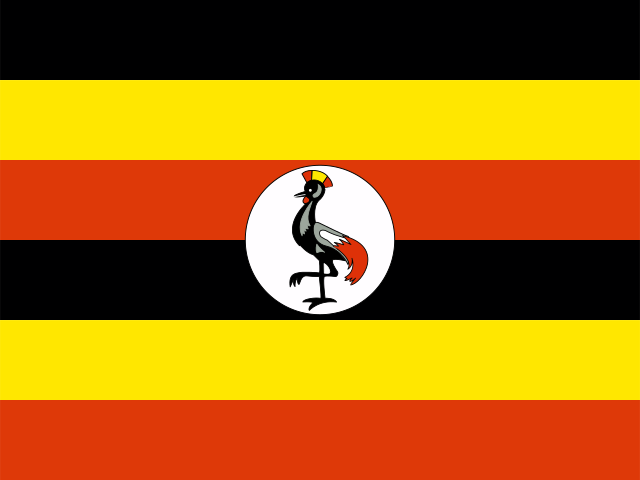
The Ugandan flag consists of six horizontal stripes in the order black, yellow, red, black, yellow, red. Centered on the flag is a white disc bearing a grey crowned crane facing the hoist. The proportion is 2:3. It was adopted on 9 October 1962, when Uganda gained independence from Britain, and has remained unchanged since.
Colors and meaning
Black represents the African people of Uganda and the African continent, yellow represents the abundant sunshine that Uganda enjoys, and red represents the brotherhood and blood that connects all Africans. The grey crowned crane in the center is Uganda's national bird and a symbol of the country's gentle nature.
Black
Represents the African people of Uganda and the wider African continent. The color acknowledges the shared heritage of all Africans.
Yellow
Represents the abundant sunshine that Uganda enjoys throughout the year. Uganda's position on the equator gives it a warm, sunny climate, which supports its rich agriculture.
Red
Represents the brotherhood of all Africans and the blood that connects them — a Pan-African symbol of unity and shared struggle.
Grey crowned crane
The national bird of Uganda, seen on the flag facing the hoist. The crane is known for its gentle nature and was chosen as a symbol of Uganda's peaceful character. It appears on a white disc, which serves as a background for the bird. The raised leg of the crane is said to represent the forward march of the nation.
History and adoption
Uganda became a British protectorate in 1894 and gained independence on 9 October 1962. The flag was designed by Grace Ibingira, then Uganda's Minister of Justice, and was adopted on the day of independence. The design combined the colors used by the Uganda People's Congress (black, yellow and red) with the grey crowned crane, which had been used as a symbol of Uganda since the colonial period. The flag has remained unchanged since independence, including through the political turmoil of the 1970s and 1980s under Milton Obote and Idi Amin.
Key facts
- Adopted
- 9 October 1962
- Proportion
- 2:3
- Designer
- Grace Ibingira
- Capital
- Kampala
- Country code
- UG
- Similar flags
- None
Historical and related flags
Uganda used several flags during its colonial period before independence.
- British Uganda (1894–1914): British Blue Ensign with a colonial badge.
- British Uganda (1914–1962): Blue Ensign with a badge featuring a crane.
- Uganda Protectorate (1914–1962): Blue Ensign with the crane badge and Ugandan shield.
- Current flag (1962–present): Black, yellow and red stripes with the crested crane.
- Presidential standard: Uses the Ugandan coat of arms on a green field.
Frequently asked questions
What does the flag of Uganda look like?
The flag of Uganda has six horizontal stripes of black, yellow and red repeated twice, with a white disc in the center bearing a grey crowned crane. The proportion is 2:3.
When was the flag of Uganda adopted?
The current flag of Uganda was officially adopted on 9 October 1962.
What do the colors mean?
Black represents the African people of Uganda and the African continent, yellow represents the abundant sunshine that Uganda enjoys, and red represents the brotherhood and blood that connects all Africans. The grey crowned crane in the center is Uganda's national bird and a symbol of the country's gentle nature.
Which flags look similar to the Uganda flag?
No other national flag closely resembles Uganda's. The combination of six alternating black, yellow and red stripes with a central crested crane is unique.

 Kenya
 Tanzania
 Rwanda
 South Sudan
 DR Congo
 Burundi