What the flag looks like
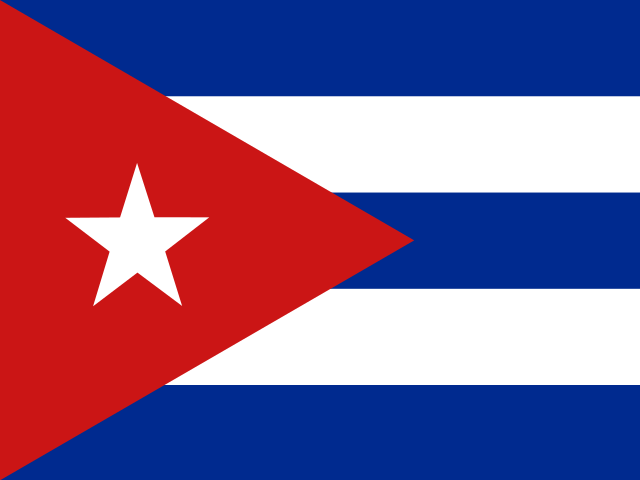
The Cuban flag consists of five equal horizontal stripes of blue and white, alternating with blue at the top and bottom, and a red equilateral triangle at the hoist bearing a white five-pointed star in its center. The proportion is 1:2. It was designed in 1849 by Miguel Teurbe Tolón and adopted as the national flag of Cuba on 20 May 1902, when Cuba gained independence from the United States.
Colors and meaning
Blue represents the three departments of Cuba at the time of independence (Western, Central and Eastern), white represents the purity of Cuban patriotism, and red represents the blood shed for independence and courage. The white star represents Cuba's independence and freedom, and the red triangle represents liberty, equality and fraternity, inspired by the French Revolution.
Blue
The three blue stripes represent the three historical departments of Cuba at the time of independence: Western (Pinar del Río, Havana, Matanzas), Central (Las Villas, Camagüey) and Eastern (Oriente).
White
The two white stripes represent the purity of Cuban patriotism and the desire for a free and peaceful nation.
Red triangle
Represents liberty, equality and fraternity — the ideals of the French Revolution — and the blood shed by Cuban patriots in the struggle for independence from Spain.
White star
Represents Cuba's independence and freedom. The star inspired the flag's nickname 'La Estrella Solitaria' (The Lone Star), shared with Chile and Puerto Rico, whose flags were inspired by the same design.
History and adoption
The Cuban flag was designed in 1849 by Miguel Teurbe Tolón, a Cuban exile living in New York, with input from Narciso López, a Venezuelan revolutionary. The design was inspired by the United States flag, with stripes representing the departments and a triangle representing liberty. It was first flown in 1850 during a failed attempt to liberate Cuba from Spain. The flag was formally adopted on 20 May 1902, when Cuba gained formal independence from the United States (following the Spanish–American War of 1898). The design has remained unchanged since.
Key facts
- Adopted
- 20 May 1902
- Proportion
- 1:2
- Designer
- Miguel Teurbe Tolón, Narciso López
- Capital
- Havana
- Country code
- CU
- Similar flags
- Puerto Rico, Texas, Chile
Historical and related flags
Cuba has used several flags during its colonial period and after independence.
- Spanish colonial (1510–1898): Spanish flag used during colonial rule.
- US occupation (1898–1902): United States flag flown during US military administration.
- First Republic (1902–1959): Current flag adopted at independence.
- Current flag (1959–present): Flag retained after the Cuban Revolution.
- Naval jack: Version with the triangle and star without stripes.
Frequently asked questions
What does the flag of Cuba look like?
The flag of Cuba has five horizontal stripes of blue and white, with a red equilateral triangle at the hoist bearing a white five-pointed star. The proportion is 1:2.
When was the flag of Cuba adopted?
The current flag of Cuba was officially adopted on 20 May 1902.
What do the colors mean?
Blue represents the three departments of Cuba at the time of independence (Western, Central and Eastern), white represents the purity of Cuban patriotism, and red represents the blood shed for independence and courage. The white star represents Cuba's independence and freedom, and the red triangle represents liberty, equality and fraternity, inspired by the French Revolution.
Which flags look similar to the Cuba flag?
Puerto Rico's flag uses the same design with the red and blue colors swapped. Texas and Chile use similar striped designs with a star in a canton or triangle. Cuba's specific blue-red arrangement with the red triangle on the hoist is distinct from Puerto Rico's.

 Puerto Rico
 Jamaica
 Haiti
 Dominican Republic
 Chile
 Bahamas