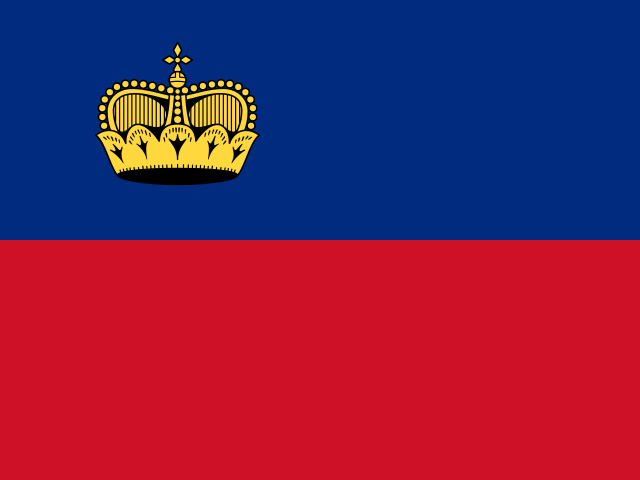
What the flag looks like
The Liechtenstein flag consists of two equal horizontal bands of blue (top) and red (bottom), with a golden princely crown in the upper hoist corner. The proportion is 3:5. It was adopted on 24 June 1937, when the crown was added to distinguish the flag from that of Haiti, which had been mistakenly used at the 1936 Summer Olympics.
Colors and meaning
Blue represents the sky over the Alpine principality and the princely family's loyalty and wisdom, red represents the courage and strength of the Liechtenstein people and the blood shed for independence, and the golden crown represents the Prince of Liechtenstein and the principality's status as a sovereign monarchy.
Blue
Represents the sky over the Alpine principality and the princely family's traditional values of loyalty, wisdom and devotion.
Red
Represents the courage, strength and warmth of the Liechtenstein people, and the blood shed in defense of the principality's sovereignty.
Golden crown
The princely crown in the upper hoist corner represents the Prince of Liechtenstein and the principality's status as a sovereign constitutional monarchy. The crown is a heraldic symbol of the House of Liechtenstein, which has ruled the principality since 1719.
Olympic incident
At the 1936 Summer Olympics in Berlin, Liechtenstein athletes discovered that their flag was identical to the flag of Haiti, which was also competing. The golden crown was added in 1937 to prevent future confusion.
History and adoption
The Liechtenstein flag was first adopted in 1921, when the principality adopted a blue-and-red horizontal bicolor based on the livery colors of the princely family. The design was identical to the flag of Haiti, which caused an embarrassing mix-up at the 1936 Summer Olympics in Berlin when Liechtenstein athletes discovered their flag was the same as Haiti's. On 24 June 1937, the golden princely crown was added to the upper hoist corner to distinguish the flag. The design has remained unchanged since, and the crown now features prominently in all official uses.
Key facts
- Adopted
- 24 June 1937
- Proportion
- 3:5
- Designer
- Traditional — based on the livery colors of the House of Liechtenstein
- Capital
- Vaduz
- Country code
- LI
- Similar flags
- Haiti
Historical and related flags
Liechtenstein has used several flags across its history, and today uses several official variants.
- Princely family (1600s–1921): Blue and red livery colors of the House of Liechtenstein.
- First national flag (1921–1937): Blue and red horizontal bands without crown.
- Current flag (1937–present): Blue and red bands with golden princely crown.
- State flag: Same as the national flag.
- Government flag: Uses the greater coat of arms of Liechtenstein.
- Princely standard: Yellow with the greater arms of the princely family.
Frequently asked questions
What does the flag of Liechtenstein look like?
The flag of Liechtenstein has two equal horizontal bands of blue (top) and red (bottom), with a golden crown in the upper hoist corner. The proportion is 3:5.
When was the flag of Liechtenstein adopted?
The current flag of Liechtenstein was officially adopted on 24 June 1937.
What do the colors mean?
Blue represents the sky over the Alpine principality and the princely family's loyalty and wisdom, red represents the courage and strength of the Liechtenstein people and the blood shed for independence, and the golden crown represents the Prince of Liechtenstein and the principality's status as a sovereign monarchy.
Which flags look similar to the Liechtenstein flag?
Haiti uses a blue and red horizontal bicolor with a white panel and coat of arms in the center. Liechtenstein's blue and red with a golden crown in the hoist corner is distinct, though the base colors are the same.

 Haiti
 Switzerland
 Austria
 Germany
 Luxembourg
 Monaco