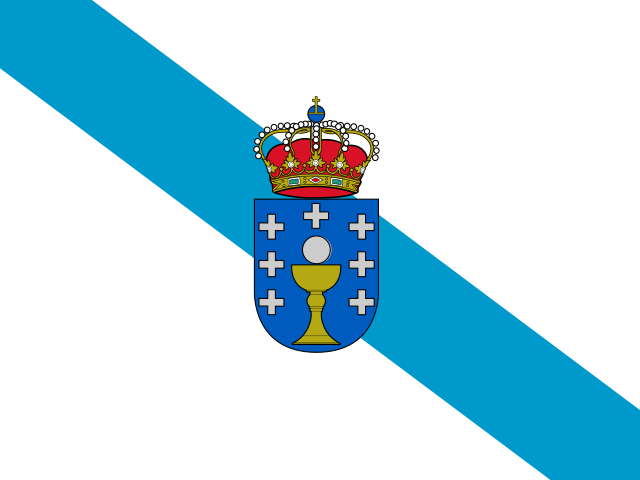
What the flag looks like
The Galician flag, known as the Bandeira de Galicia, consists of a white field with a blue diagonal band running from the upper hoist corner to the lower fly corner. The proportion is 2:3. It was formally adopted by the Galician Statute of Autonomy in 1981 and standardized in 1984. A variant that includes the Galician coat of arms in the center is also used for official purposes.
Colors and meaning
White represents purity, peace and the white of the Galician coast and its traditional fishing culture, and blue represents the Atlantic Ocean and the many rivers that flow through Galicia. Together they evoke the maritime character of the region and the devotion of the Galician people to the sea.
White field
Represents purity, peace and the maritime character of Galicia. The white also evokes the white sand of Galicia's beaches and the mist that often covers the region's green hills and rías (coastal inlets).
Blue diagonal band
Represents the Atlantic Ocean, which borders Galicia along its entire western and northern coastline, and the many rivers that cross the region — the Miño, Sil, Ulla and Tambre. The blue diagonal band is a distinctive feature of the flag and recalls the diagonal bands used on many European regional flags.
Historical origin
The design is believed to have originated in the 19th century, when Galician sailors used a white flag with a blue diagonal band as an ensign for the Galician maritime province. The design was also used during the brief Galician Republic of 1931 and was revived during the transition to democracy in the late 1970s.
Coat of arms variant
A variant of the flag includes the Galician coat of arms in the center — a chalice (representing the Holy Grail, which is said to be kept in the cathedral of Valencia... actually, in Galicia, at Santiago de Compostela) surrounded by seven crosses. This variant is used for official purposes by the Galician government.
History and adoption
Galicia has a long history as a distinct cultural and linguistic region in northwestern Spain. The current flag design is believed to date from the 19th century, when Galician sailors used a white flag with a blue diagonal band as an ensign. The flag was used during the brief Galician Republic of 1931 and then suppressed under Franco's dictatorship (1939–1975), when regional symbols were banned. Following the transition to democracy, the flag was formally adopted by the Galician Statute of Autonomy, approved in 1981, and standardized in 1984. It has remained the official flag of the autonomous community of Galicia since. The Galician language, closely related to Portuguese, is co-official with Spanish in the region.
Key facts
- Adopted
- 1981 (standardized 1984)
- Proportion
- 2:3
- Designer
- Traditional 19th-century design
- Capital
- Santiago de Compostela
- Country code
- ES-GA
- Similar flags
- None
Historical and related flags
Galicia has used several flags across its history, and variants of the modern flag exist.
- Galician maritime province (19th century): White field with a blue diagonal band, used as an ensign.
- Galician Republic (1931): Same design used briefly during the short-lived Galician Republic.
- Franco era (1939–1975): Regional flag banned; Spanish flag used.
- Current flag (1981–present): White field with a blue diagonal band, adopted by the Statute of Autonomy.
- Coat of arms variant: White field with a blue diagonal band and the Galician coat of arms in the center, used for official purposes.
Frequently asked questions
What does the flag of Galicia look like?
The flag of Galicia is a white field with a blue diagonal band running from the upper hoist corner to the lower fly corner. The proportion is 2:3.
When was the flag of Galicia adopted?
The current flag of Galicia was officially adopted on 1981 (standardized 1984).
What do the colors mean?
White represents purity, peace and the white of the Galician coast and its traditional fishing culture, and blue represents the Atlantic Ocean and the many rivers that flow through Galicia. Together they evoke the maritime character of the region and the devotion of the Galician people to the sea.
Which flags look similar to the Galicia flag?
No other national or regional flag closely resembles Galicia's. The combination of a white field with a blue diagonal band is unique, though several other European regions and countries (such as the Democratic Republic of the Congo, Tanzania and Namibia) use diagonal bands in different colors.

 Spain
 Portugal
 Catalonia
 France
 European Union
 Andorra