What the flag looks like
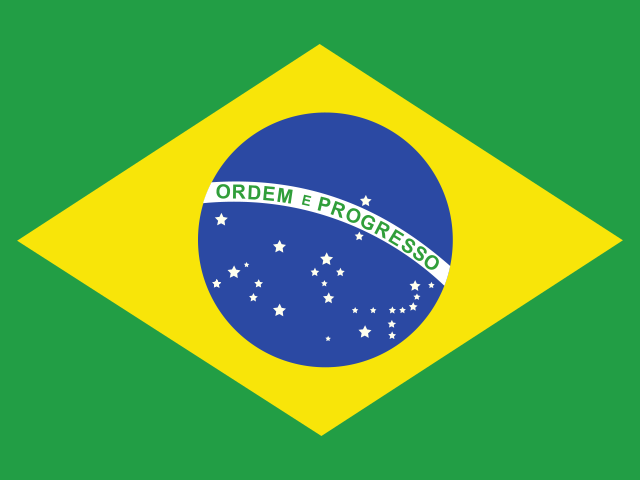
The Brazilian flag consists of a green rectangle, a yellow rhombus centered on it, and a blue circle with white stars and a white equatorial band bearing the national motto 'Ordem e Progresso'. The flag proportion is 7:10. It was adopted on 19 November 1889, four days after the proclamation of the republic, and its current form (with 27 stars) dates from 1992.
Colors and meaning
Green represents the House of Braganza and Brazil's forests, yellow represents the House of Habsburg and the country's gold, and blue represents the sky over Rio de Janeiro on the morning of 15 November 1889. The 27 stars represent the 26 states and the Federal District, and the motto 'Ordem e Progresso' is inspired by Auguste Comte's positivism.
Green
Represents the forests of Brazil and the House of Braganza, the imperial dynasty that ruled Brazil until 1889.
Yellow
Represents Brazil's gold reserves and the House of Habsburg, to which Empress Maria Leopoldina belonged.
Blue
Represents the sky over Rio de Janeiro on 15 November 1889, the day the republic was proclaimed. The stars are arranged as seen from that location at that moment.
White
Used for the stars, the motto band and the border of the rhombus — representing peace and purity.
Stars
There are 27 stars — one for each state plus the Federal District. Nine star sizes correspond to the states' sizes on the actual Brazilian sky.
Ordem e Progresso
The motto means 'Order and Progress' and is derived from Auguste Comte's positivist slogan 'L'amour pour principe et l'ordre pour base; le progrès pour but'.
History and adoption
The Brazilian flag was adopted on 19 November 1889 by decree of the provisional republican government, four days after the monarchy was overthrown. It was designed by Raimundo Teixeira Mendes, Miguel Lemos, Manuel Pereira Reis and Décio Villares, drawing on the flag of the earlier Empire of Brazil (green field, yellow rhombus, imperial coat of arms). The republican design replaced the coat of arms with a blue celestial globe. The flag has been updated several times as new states were created — the most recent change added a 27th star in 1992.
Key facts
- Adopted
- 19 November 1889 (current version 11 May 1992)
- Proportion
- 7:10
- Designer
- Raimundo Teixeira Mendes, Miguel Lemos, Manuel Pereira Reis, Décio Villares
- Capital
- Brasília
- Country code
- BR
- Similar flags
- None
Historical and related flags
Brazil has had several national flags since independence in 1822. Each was built around the same green-and-yellow palette but with different central emblems.
- Empire of Brazil (1822–1889): Green field, yellow rhombus, imperial coat of arms in the center.
- Republic (1889–1960): The current design with 21 stars, adding one per new state over time.
- Republic (1960–1992): 22 stars after the creation of Guanabara and later the Federal District.
- Current version (1992–present): 27 stars, matching the current federal units.
Frequently asked questions
What does the flag of Brazil look like?
The flag of Brazil has a green background, a yellow rhombus in the center, and a blue circle with 27 white stars and a white band reading 'Ordem e Progresso' ('Order and Progress').
When was the flag of Brazil adopted?
The current flag of Brazil was officially adopted on 19 November 1889 (current version 11 May 1992).
What do the colors mean?
Green represents the House of Braganza and Brazil's forests, yellow represents the House of Habsburg and the country's gold, and blue represents the sky over Rio de Janeiro on the morning of 15 November 1889. The 27 stars represent the 26 states and the Federal District, and the motto 'Ordem e Progresso' is inspired by Auguste Comte's positivism.
Which flags look similar to the Brazil flag?
The Brazilian flag is unique among national flags for its astronomical globe. No other country's flag is closely comparable.

 Argentina
 Uruguay
 Colombia
 Venezuela
 Portugal
 Paraguay