What the flag looks like
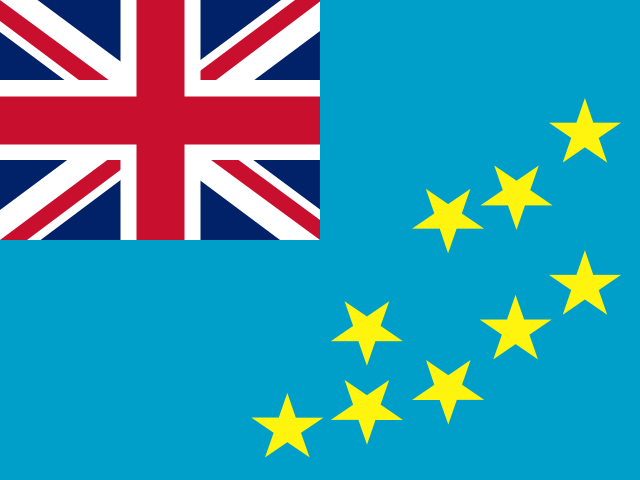
The Tuvaluan flag consists of a light blue field with the Union Jack in the upper hoist canton and nine golden-yellow five-pointed stars on the fly side, arranged in the same pattern as the nine islands of Tuvalu on a map. The proportion is 1:2. It was originally adopted on 1 October 1978, when Tuvalu gained independence from Britain. A modified version was used from 1995 to 1997, but the current design was restored on 11 April 1997.
Colors and meaning
Light blue represents the Pacific Ocean that surrounds Tuvalu's nine islands, the Union Jack represents Tuvalu's historical ties to Britain and the Commonwealth, and the nine golden stars represent the nine islands of Tuvalu — Funafuti, Nanumea, Nui, Nukufetau, Nukulaelae, Vaitupu, Nanumanga, Niutao and Niulakita.
Light blue field
Represents the Pacific Ocean that surrounds Tuvalu's nine coral atolls, which are scattered across about 1.3 million square kilometers of ocean. The light blue color is lighter than the traditional British Blue Ensign blue, reflecting the tropical Pacific setting.
Union Jack
Represents Tuvalu's historical ties to Britain and its membership in the Commonwealth of Nations. Tuvalu was a British colony (as part of the Gilbert and Ellice Islands) from 1892 to 1978, when it became fully independent as a Commonwealth realm with the British monarch as head of state.
Nine golden stars
Represent the nine islands of Tuvalu — Funafuti, Nanumea, Nui, Nukufetau, Nukulaelae, Vaitupu, Nanumanga, Niutao and Niulakita. The stars are arranged on the fly side of the flag to roughly match the geographical arrangement of the islands, with Funafuti (the capital atoll) at the top and the outer islands below.
Design history
The current design was adopted on 1 October 1978, when Tuvalu gained independence from Britain. In 1995, a new flag was adopted that removed the Union Jack and added a red field with a blue canton. This design was unpopular, and in 1997 the original design was restored with minor modifications (the number of stars was fixed at nine). It has remained unchanged since.
History and adoption
Tuvalu, formerly known as the Ellice Islands, was a British protectorate from 1892 and part of the Gilbert and Ellice Islands Colony from 1916. In 1974, the Ellice Islands voted to separate from the Gilbert Islands (now Kiribati), and on 1 October 1978, Tuvalu gained independence as a Commonwealth realm. The current flag was adopted on independence day, based on the British Blue Ensign with nine golden stars added to represent the country's nine islands. In 1995, the government of Prime Minister Kamuta Latasi replaced the flag with a new design that removed the Union Jack, but the change was unpopular, and after a change of government in 1996, the original design was restored on 11 April 1997 with the number of stars fixed at nine. The flag has remained unchanged since.
Key facts
- Adopted
- 1 October 1978 (restored 11 April 1997)
- Proportion
- 1:2
- Designer
- Based on the colonial Tuvaluan Blue Ensign
- Capital
- Funafuti
- Country code
- TV
- Similar flags
- Australia, New Zealand, Fiji
Historical and related flags
Tuvalu has used several flags across its British colonial and independence periods.
- Gilbert and Ellice Islands (1892–1976): British Blue Ensign with a colonial badge featuring a frigate bird and waves.
- Tuvalu colony (1976–1978): Blue Ensign with a Tuvaluan badge.
- First national flag (1978–1995): Light blue field with Union Jack and nine golden stars.
- Latasi flag (1995–1997): Red field with blue canton and stars, without the Union Jack.
- Current flag (1997–present): Original design restored with nine stars fixed.
- Governor-General's standard: Uses the Tuvaluan coat of arms on a blue field.
Frequently asked questions
What does the flag of Tuvalu look like?
The flag of Tuvalu is a light blue field with the Union Jack in the upper hoist canton and nine golden-yellow five-pointed stars on the fly side, arranged to represent the nine islands of Tuvalu. The proportion is 1:2.
When was the flag of Tuvalu adopted?
The current flag of Tuvalu was officially adopted on 1 October 1978 (restored 11 April 1997).
What do the colors mean?
Light blue represents the Pacific Ocean that surrounds Tuvalu's nine islands, the Union Jack represents Tuvalu's historical ties to Britain and the Commonwealth, and the nine golden stars represent the nine islands of Tuvalu — Funafuti, Nanumea, Nui, Nukufetau, Nukulaelae, Vaitupu, Nanumanga, Niutao and Niulakita.
Which flags look similar to the Tuvalu flag?
Australia, New Zealand and Fiji use similar blue fields with the Union Jack in the canton and stars or shields on the fly. Tuvalu's nine golden stars arranged in the geographic pattern of its islands distinguish it from the others.

 Kiribati
 Fiji
 Australia
 New Zealand
 Samoa
 Nauru