What the flag looks like
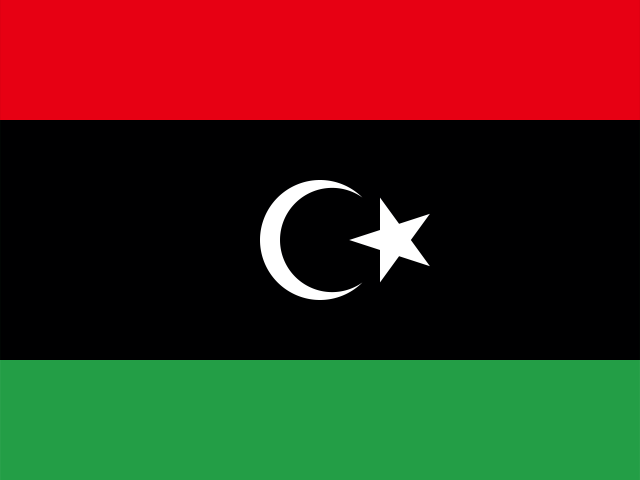
The Libyan flag consists of three horizontal bands of red (top), black (center, twice as wide as the others) and green (bottom), with a white crescent moon and a white five-pointed star in the center of the black band. The proportion is 1:2. It was originally adopted on 24 December 1951, when Libya gained independence, and was readopted on 17 February 2011, following the fall of Muammar Gaddafi.
Colors and meaning
Red represents the blood shed for Libyan independence, black represents the dark years of foreign rule and the courage of the Libyan people, and green represents Islam, prosperity and hope for the future. The white crescent and star are traditional symbols of Islam.
Red
Represents the blood shed by Libyan patriots in the struggle for independence and the courage of the Libyan people. It is the top band of the flag.
Black
Represents the dark years of foreign rule — Ottoman, Italian and later foreign interference — and the determination of the Libyan people to overcome it. Black is also the color of the banner of the Senussi dynasty, which led Libya to independence in 1951.
Green
Represents Islam, prosperity and hope for a bright future. Green is a traditional Islamic color and appears on many Muslim flags.
Crescent and star
Traditional symbols of Islam. The crescent and five-pointed star sit in the center of the black band, representing the faith and unity of the Libyan people.
Senussi origin
The design was created by Omar Faiek Shennib and approved by King Idris I of the Senussi dynasty. It was based on the banner of the Senussi Order, which used red, black and green colors.
History and adoption
Libya gained independence from Italy on 24 December 1951 under King Idris I, and the red-black-green tricolor with crescent and star was adopted the same day. In 1969, Muammar Gaddafi overthrew the monarchy in a coup and initially kept the flag, before replacing it in 1972 with a red-white-black flag with the Eagle of Saladin, and later, in 1977, with a plain green flag — the only national flag in the world with just one color and no design. During the 2011 Libyan Civil War, the original independence flag was readopted by the National Transitional Council on 17 February 2011, and it was confirmed as the national flag after Gaddafi's fall. The design has remained unchanged since.
Key facts
- Adopted
- 24 December 1951 (readopted 17 February 2011)
- Proportion
- 1:2
- Designer
- Omar Faiek Shennib
- Capital
- Tripoli
- Country code
- LY
- Similar flags
- None
Historical and related flags
Libya has used several flags across its monarchic, Gaddafi and post-revolution periods.
- Italian Libya (1911–1943): Italian flag used during colonial rule.
- Kingdom of Libya (1951–1969): Current design adopted at independence.
- Libyan Arab Republic (1969–1972): Same flag briefly retained after the coup.
- Federation of Arab Republics (1972–1977): Red-white-black tricolor with the Eagle of Saladin.
- Great Socialist People's Libyan Arab Jamahiriya (1977–2011): Plain green flag.
- Current flag (2011–present): Independence-era design restored.
Frequently asked questions
What does the flag of Libya look like?
The flag of Libya has three horizontal bands of red (top), black (middle, twice as wide) and green (bottom), with a white crescent and white five-pointed star centered on the black band. The proportion is 1:2.
When was the flag of Libya adopted?
The current flag of Libya was officially adopted on 24 December 1951 (readopted 17 February 2011).
What do the colors mean?
Red represents the blood shed for Libyan independence, black represents the dark years of foreign rule and the courage of the Libyan people, and green represents Islam, prosperity and hope for the future. The white crescent and star are traditional symbols of Islam.
Which flags look similar to the Libya flag?
No other national flag uses the same red-black-green horizontal arrangement with a central white crescent and star. Libya's design is unique.

 Egypt
 Tunisia
 Algeria
 Sudan
 Morocco
 Turkey